
Animal advocates typically oppose hunting. Anti-hunting activism is one of the few popular interventions to improve wild-animal welfare for the animals’ own sake (rather than for the sake of conservation or human benefit). Unfortunately, I think anti-hunting activism is often misguided.
Some popular kinds of hunting present few direct welfare issues. Indeed, they plausibly cause a significantly less painful death than the animal would otherwise have. I also think that hunting could potentially be a useful management tool in ecosystems managed to improve wild-animal welfare, and I think it’s bad to dismiss this tool out of hand because we assumed without evidence that it’s bad for the animals.1
Now, the study of hunting and animal welfare has a lot of methodological issues. For one thing, almost all the rigorous studies are conducted by a single researcher, Jordan Hampton.

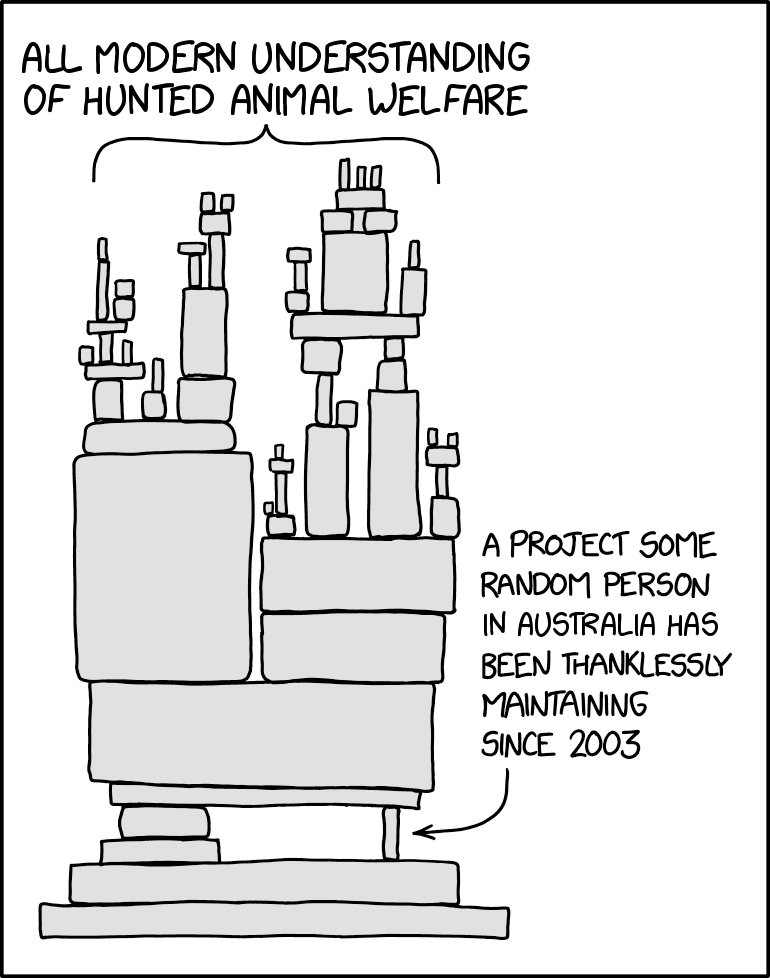
Over the course of my research, I have developed a parasocial relationship with Jordan Hampton. He is the only person writing papers about hunting that aren’t stupid. For example, instead of looking at the injuries on dead animals’ bodies and trying to figure out how much they suffered, Jordan Hampton pioneered the innovative technique of actually going with hunters into the field, watching them kill animals, and writing down how long it took the animals to die. Our entire civilization’s understanding of the welfare of hunted animals rests on the shoulders of one Australian.
Anyway, if it turned out that Jordan Hampton was faking his data or something, we’d be totally fucked.
The other big methodological issue is that “hunting” refers to wildly different activities. It is “hunting” to shoot a deer who never notices you were there, dies instantly, and would have starved to death otherwise because deer are overpopulated in the area. It is also “hunting” to terrify an entire herd of feral pigs by shooting at them from a helicopter, aim poorly, and condemn four animals to lingering painful deaths and one escapee to lifelong chronic pain. Obviously, these have very different effects on the animals!
In particular, studies typically focus on large mammals. It’s unclear how the results generalize to birds, small mammals, or other taxa, and it’s likely that they have different experiences than large mammals do. And because Jordan Hampton is responsible for most of the useful papers in this area, we know very little about hunting and animal welfare on continents other than Australia.
How Is Hunting Bad For Animals?
This might seem like a stupid question—the animal is dead, duh. But if we’re going to think through what the harms of hunting are, we need to get clear on what the harms of hunting might be.
First, it might be wrong to kill an animal for non-consequentialist reasons—for example, maybe it’s always wrong to kill a sentient being. This is an interesting philosophical question that I’m not going to talk about in this article, since presumably you can lay out the considerations for and against it yourself.
Second, if an animal dies prematurely, she wouldn’t have all the experiences she would have if she had gotten to live longer. Some of these experiences are likely pleasurable, like sex, play, eating, grooming, and parenting. Some of these experiences are likely painful, such as injury, starvation, excessive heat or cold, or social rejection. It’s, uh, controversial among wild-animal welfare advocates whether wild animals in general have lives worth living.2 I don’t know by how much hunting typically shortens a wild animal’s life; as far as I can tell, no one has ever studied this.
Similarly, in social species, other animals may miss the prematurely killed animal (even if they don’t have an understanding of “death” per se). If the prematurely killed animal was a parent, their death might threaten their young. Again, I don’t know by how much hunting typically shortens a wild animal’s life, so it’s hard to get a sense of the scope of this problem.
Third, dying itself is typically painful. I will discuss this in the section ‘Pain of Death.’
Fourth, the experience of being hunted may cause fear and stress. I will discuss this in the section ‘Stress.’
Fifth, there are various flow-through effects related to hunting. For example, hunting may decrease the population of the target species, which has various effects on the experiences of the survivors and other species in the ecosystem. Hunters might advocate for certain policies, such as vaccinations, predator control, or keeping game species populations high. Hunting might decrease human respect for wild animals or increase human willingness to intervene in nature. These flow-through effects might well have a larger effect size than hunting itself, but I don’t know how to think about them so I’m going to ignore them.
Pain of Death
One way to measure the pain a dying animal experiences is to measure the amount of time it takes for the animal to become unconscious. Intuitively, if an animal becomes unconscious immediately, she likely suffers little, if at all. Conversely, if an animal takes hours to die, she will likely suffer a great deal.
(Mostly Large) Mammals
Substack doesn’t have good embedding of tables, so after some woe I have decided to include a link. Here’s an excerpt from the table, just so you get an idea:
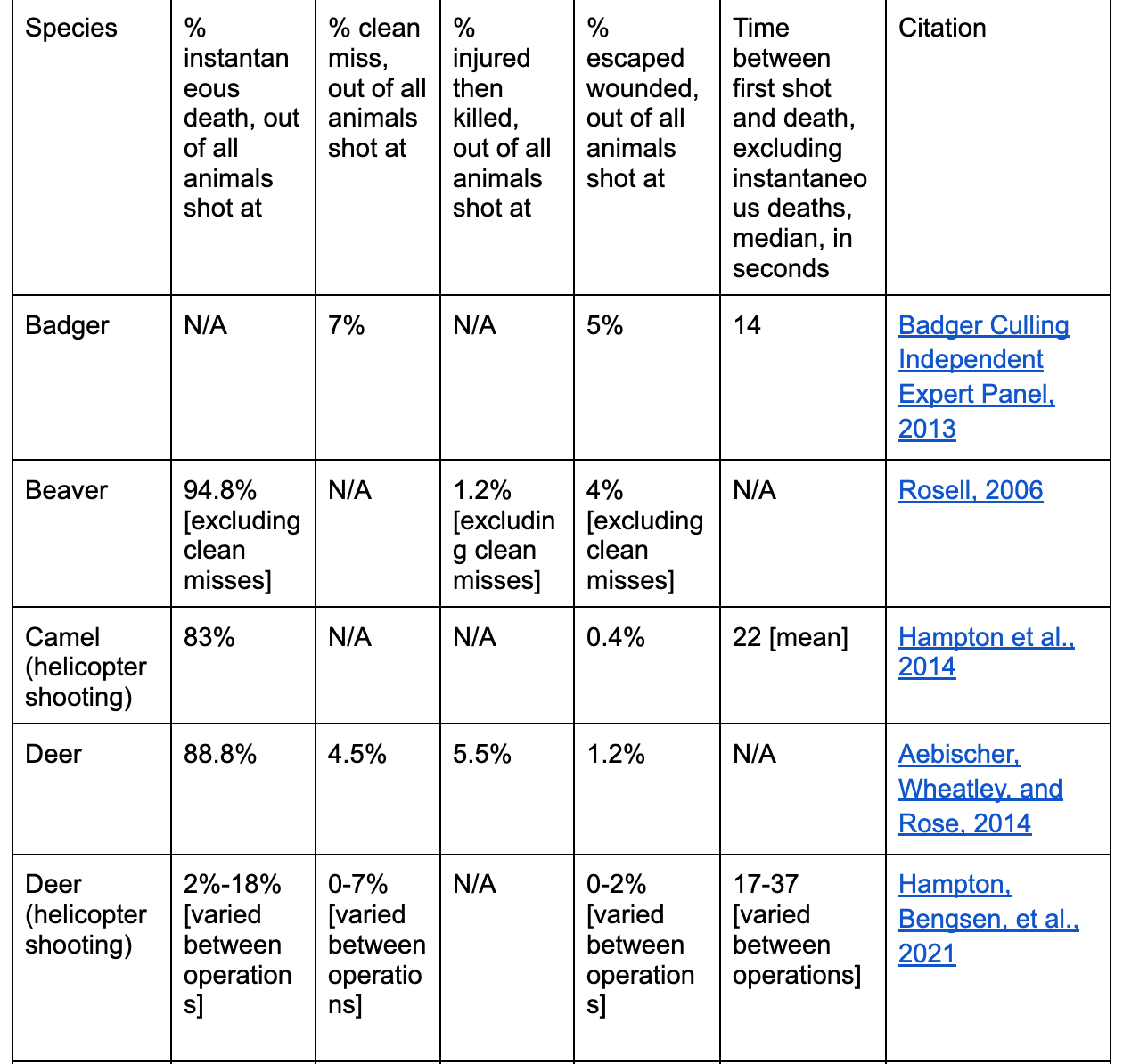
Time to death is defined as the interval from the first shot being fired until the time the animal falls and doesn’t move. This isn’t perfectly accurate—an animal might be unable to move but still alive. However, since most hunting occurs at a distance, it’s not practical to use some more accurate metric. Death or unconsciousness probably follows within a few seconds at most.
Instantaneous death rate is the proportion of animals for whom time to death is zero; these animals can be presumed to experience little or no suffering. A clean miss was fired, but didn’t injure the animal; note that some reported “clean misses” might have actually hit the animal, but observers couldn’t see it. Animals injured then killed were shot non-fatally at first, then shot additional times, killing them. Animals which escape wounded were shot but not killed; presumably they either die of their injuries hours or days later or are disabled in the long term.
The rows don’t necessarily add to 100% because sometimes an animal takes a while to die but isn’t shot multiple times in the process.
Unless noted, all studies are of animals that were stalked (pursued stealthily on foot by a hunter).
General conclusions:
With the exception of rabbits, animals shot from a helicopter, and red deer, upwards of 80% of hunted animals die instantaneously.3
Rabbits are the smallest animals studied so presumably the hardest to aim at? Similarly, presumably it’s hard to aim well from a helicopter?
I don’t understand why red deer have relatively bad instantaneous death numbers though.
Of the remaining animals, median time to death was generally less than a minute.
In all species except rabbits, less than 10% of animals escape wounded.
In some species, no animals escape wounded.
In conclusion, the deaths of hunted large mammals are usually quick and clean. I am somewhat concerned about rabbits.
Birds
The evidence about bird hunting, conversely, is scanty.
A study of nine bird species in Northwestern Europe found that 17% carried embedded shotgun pellets, with larger species being more likely to have embedded shotgun pellets. Bewick’s swans had the highest rate of embedded shotgun pellets (33%) while dark-belled brent geese had the lowest (4%). Adults had a higher rate of embedded shotgun pellets than juveniles. Most individuals with an embedded pellet had only one embedded pellet, but one greylag goose had 28 pellets (!). Unfortunately, this study doesn’t give us information about whether birds with embedded pellets experience impairment or chronic pain, but it does suggest that birds escaping wounded are quite common.
The rate of mourning doves shot but not recovered is highly variable over time, ranging between 18% and 50% and averaging about 25%. Hunters, however, report about 30% fewer doves shot but not recovered—about 15% to 18% of doves. A study of pink-footed geese found that at least 0.7 birds were wounded per bird killed. If hunters use lead shot, about 23% of hunted ducks and goose escape wounded. Conversely, after a lead ban, only about 15% of hunted ducks and 10% of hunted geese escaped wounded.
In a population of common eiders, 29% of adults, 18% of immature birds, and 15% of juveniles had lead shot embedded within them. Embedded birds had 1 to 7 pellets, with juveniles typically having more pellets within them than older birds. Wounded and unwounded birds had similar body condition, although unwounded juveniles had more fat than wounded birds of the same age. Since juvenile common eiders make up the majority of harvested common eiders, this probably means that wounded juvenile common eiders have less fat because of their injuries, and so they die before they grow up. Among older common eiders, injuries don’t seem to cause poor body condition in the long term (although they might cause chronic pain or other welfare issues).
My guess here is that birds escaping wounded is very common (more than 10% and less than half?). Many birds seem to survive a while with wounds. I’m not sure how much of a serious welfare concern this is.
Stress of Death
Acute Stress
The experience of being hunted (separately from the experience of dying) might cause an animal suffering. To figure out whether an animal experiences suffering when it dies, researchers typically look at biomarkers of acute stress:
“Acute stress” is a cluster of physiological responses that prepares the animal for dealing with certain situations that are, well, stressful. Acutely stressed animals are stronger, have more energy, and think faster. The animal’s body draws energy away from less urgent things—eating, digesting, trying to seduce other animals, exploring—and towards more urgent things, like fighting or running away. You’ve felt acute stress before: you feel it when you are running to catch a bus, making a speech in front of a crowd, talking to someone you want to impress, or half-watching your kid and half-watching TV and then you realize you haven’t heard anything for the past five minutes.
Acute stress doesn’t necessarily mean an animal is unhappy. The acute stress response is a preparation for action, not an indicator of poor welfare. An animal might experience an acute stress response when having sex, running towards some tasty food, or even playing, without actually being unhappy in any way. However, we can make the shrewd guess that animals who were experiencing an acute stress response while being hunted weren’t doing so because of how ecstatically, orgasmically happy they are about being shot at.
Shot animals consistently experience less acute stress than animals caught in traps (see Marks, 2010; Jacobson, Kirkpatrick, and McGinnis, 1978; Hamilton and Weeks 1985; Westhoff et al., 2022). In general, trapped animals show signs of dehydration, intense activity, and an acute stress response, which is consistent with a terrifying, slow, and painful death. Shot animals don’t show these signs nearly as strongly.
In general, stalked animals (that is, animals pursued stealthily on foot by a hunter) show very few signs of acute stress (see Bradshaw and Bateson, 2000; Gentsch, Kjellander, and Röken, 2018; Cockram et al, 2011). Although these studies are generally of wild ungulates, I think they generalize, because stalked animals might not realize that they were being hunted until they were shot. Red deer stalked by more than one hunter tend to experience more stress than animals stalked by only one hunter, presumably because they’re more likely to notice that they’re being hunted; again, I expect this generalizes.
In roe deer but not moose, red deer, or fallow deer, battue (the use of beaters to drive the animal towards the hunter) causes more stress in hunted animals than stalking does.
Hunting animals with a helicopter is stressful for the animals. Indeed, in red deer, helicopter hunting is the only form of culling more stressful than death in a slaughterhouse.
Hunting with dogs is also stressful for animals. For example, in deer, hunting with dogs is associated with higher levels of stress than stalking. In a study of mountain hares, blood cortisol levels were 6.6 times higher in mountain hares hunted with dogs than in mountain hares hunted without dogs. (Some hares hunted without dogs were chased briefly, while others were shot without a chase.)
In a study of wild boar, a driven hunt, in which a line of beaters with dogs chases boar towards stationary hunters, was more stressful than an enclosure hunt, which also involves beaters and dogs but in a smaller, confined area. The least stressful option was a high-seat hunt, which is the equivalent of stalking for boar—a single hunter quietly waits for a single, unsuspecting animal. Another study also found that a high-seat hunt was less stressful than a driven hunt. The difference in cortisol levels was statistically significant at p < 0.0001, which is really the sort of p-value I associate more with physics than with research into the behavior of macroscopic particles.
In another study, about half of boar killed in drive hunts had a cortisol level that indicates trauma, while 40% had a normal cortisol level. (A boar with a normal cortisol level might still be experiencing acute stress, just less extreme.)
A particularly striking study compared red deer hunted with dogs to red deer euthanized because it was inhumane to allow them to continue suffering that intensely. The biomarkers indicate that the hunted red deer were more stressed than the euthanized red deer. Now, this is an unusual case in many ways—red deer don’t run long distances in the wild, and red deer hunts regularly last for over an hour. But I think this study should provide convincing evidence that some forms of hunting are frankly sadistic and should be banned in a civilized society.
However, it is inappropriate to generalize from that study to all hunting. To be perfectly frank, it is difficult to imagine that much suffering is experienced by an animal that doesn’t realize that she’s being hunted until a bullet goes through her head, killing her within a few seconds. We should all have deaths that painless!
In social species, hunting with dogs or helicopters is presumably also stressful for the animals who didn’t get shot at, but as far as I know no one has studied this.
Chronic Stress
One study looked at biomarkers of chronic stress—that is, the long-term stress that is far more closely associated with poor welfare. Unlike acute stress, chronic stress is always a welfare issue; human equivalents are poverty, abuse, depression, and grief.
The study looked at levels of cortisol and its metabolites in the hair, feces, and blood of red deer hunted using dogs. The blood samples reflect the animal’s immediate physiological state; the fecal sample, its state over the past week or so; and the hair sample, its state over the past few weeks to months.
In general, blood cortisol levels decreased over the course of the hunting season, indicating some level of acclimation to the stressor (although without a control group it’s impossible to say how stressed the animals were even after acclimation). Fecal cortisol metabolites were higher in samples from hunted deer than in samples picked up noninvasively from an area where hunting isn’t allowed. Hair cortisol concentrations increased gradually over the course of the hunting season.
These results suggest that red deer hunted with dogs are in a state of persistent chronic stress. However, unless this study’s results are replicated in other species and with other types of hunting, it is impossible to determine whether the problem is hunting in general, or hunting red deer with dogs specifically. (You will note that I previously called “hunting red deer with dogs” a sadistic form of hunting that should be banned in any civilized society.)
Another study shows that, in male roe deer, hair cortisol concentrations are higher at the end of the hunting season than at the beginning. However, the hunting season also overlaps the mating season, so it’s impossible to tell whether roe deer are stressed by hunting or by mating-associated aggression and territorial behavior.
As far as I can tell, no one else has looked into chronic stress in hunted animals? Come on, guys. Jordan Hampton can’t do everything.
Conclusions
Wild-animal welfare advocates should oppose some forms of hunting. Animals shouldn’t be hunted with helicopters or dogs; they shouldn’t be chased for hours; they shouldn’t be trapped; I’d even argue against the use of battue. But stalking— which is the most common form of hunting—presents no serious direct welfare issues.
Looking at these studies, I start to ask myself whether wild-animal welfare advocates should actively support stalking, in at least some circumstances.
Unfortunately, studies almost never compare hunted animals to animals that died from a cause totally unrelated to humans. We can make some reasonable guesses about the relative welfare impacts of different ways that humans kill animals, but we can say very little about whether the average animal killed by a hunter experiences a more or less pleasant death than the average animal who dies from predation, disease, injury, parasitism, or starvation.
So what do we know?
The best resource I know on the causes of wild animal death is this from the Wild Animal Initiative. Predation is by far the most common non-hunting cause of death for both wild birds and wild mammals of all ages. (Presumably this is because sick or malnourished animals tend to be killed by predators before they die of illness or starvation.) We know very little about how much suffering is caused by the average death by predation. It seems unlikely to me, however, that predation is consistently a more pleasant death than being shot. If I had to pick, I personally would choose to be shot rather than eaten by a lion.
In ungulates, shooting injuries generally resulted in lower cortisol levels than did vehicle collisions, injury, disease, and entanglement in nets or fences, all relatively common causes of death for ungulates. Shot rabbits have lower levels of cortisol than rabbits caught through falconry. If you assume that falconry is sort of like predation, then it seems like shooting is less stressful than predation. Similarly, hunting with dogs is quite stressful, and it seems sort of like predation.
Nevertheless, certainly at least some animal deaths are more painful than stalking. People often reject vaccinations, predator removal, supplemental feeding, and other wild-animal welfare interventions because these interventions will increase animal populations to an unsustainable level and cause more suffering in the long run. But—at least sometimes—it seems to me that we could do these interventions and then kill the excess animals through stalking.
Some animal advocates would object that we should instead control wildlife populations through contraception. I am a huge supporter of wildlife contraception. But, right now, wildlife contraception is expensive, which means that it will only realistically be used in the most photogenic and charismatic of species. Mass wildlife contraception is simply not practical any time soon. Not only will people stalk animals for free, they will pay for the privilege. Stalking is so extraordinarily cost-effective that I think it’s a mistake to rule out its use as part of a comprehensive wild-animal welfare management plan.
Again, many forms of hunting present serious wild-animal welfare issues. And it is legitimate to be opposed to killing all animals, even if the animal experiences far less suffering than they would have if you didn’t kill them. But some forms of hunting clearly don’t cause much if any animal suffering, and I think many animal advocates should reconsider their opposition.
Of course, if you think it’s morally wrong to kill animals, you would want to not employ hunting as a management tool.
Remember this doesn’t necessarily mean that the animal actually dies instantaneously, just that the animal fell down and didn’t move.
This is actually an issue that hunters have talked a lot about! I have lived in many rural areas where hunting is common. Here are some important parts of the conversation I've heard:
1. A significant amount of land conservation in the United States was originally driven by hunters. Even to this day, much conservation funding comes from hunting licenses. If you think wildlife habitat is a good thing, hunters will often be among your strongest allies.
2. Hunters are people who spend significant time in nature, paying close attention to nature (if only to find the deer). In general, many hunters really like nature.
3. Many hunting cultures have strong ethical traditions. For example, if I were to shoot the woodchucks damaging my foundation with a .22 rifle, the local hunters would judge me. Woodchucks are basically rodent Terminators, and they survive some nasty injuries, or they die slowly over hours. This is considered a bad death. Ethical hunters care a lot about "clean" deaths. In the case of woodchucks, this means a larger caliber. Hunting wild animals with dependent young is considered especially bad, and may often be illegal. But like any ethical system, there are people who don't follow it. Game wardens actively enforce certain rules.
4. Certain predators hunt livestock or endanger rural children, and are not generally tolerated near humans. But this means that certain common species have no apex predators. White tail deer are a famous example. We can control the population to some extent by issuing doe permits. But in general, deer population is controlled by hunting via stalking. This is probably better than wolves. Also, white tail deer hunters are especially strong believers in clean kills, because deer are charismatic, but also because wounded deer are notorious for running off to die somewhere no sane person wishes to retrieve a large mammal from.
5. Much hunting is for food. For meat eaters, I strongly suspect that hunting via stalking is more humane than factory farming.
6. The people who hunt red tail deer from helicopters are probably not on speaking terms with the people who are judgy about humane woodchuck hunting technique.
7. There are significant differences between hunting and "pest control." Pest control often cares less about being humane.
Ironically, if you aim to reduce animal suffering from hunting, some hunters may be among your best allies, if approached correctly. But again, this will vary by type of hunting.
> To be perfectly frank, it is difficult to imagine that much suffering is experienced by an animal that doesn’t realize that she’s being hunted until a bullet goes through her head, killing her within a few seconds. We should all have deaths that painless!
Don't give the utilitarians any ideas!