
It is important, for the preservation of American democracy and maybe the world, that the Democrats take the House and Senate in November.
(If you don’t agree with me about this claim, I wrote a blog post about it here.)
I recommend donating to high-value political candidates. But I want to bring to everyone’s attention an equally important thing they can do to improve Democrats’ chances in November: practice mindful posting.
“Mindful posting” is making sure, whenever you post about American electoral politics, that you post only content that is going to persuade your American followers to vote for a Democrat in November.
Half of all U.S. adults say they get news often or sometimes from social media. Social media is less popular as a news source than search, TV, or news websites, but more popular than podcasts, email newsletters, or AI chatbots.1
But if you want to reach a significant number of people through TV news or news websites, you will need to be a professional journalist. Similarly, if you want to reach a significant number of people through your podcast or email newsletter, you will need to be an obsessive weirdo who responds to “how was your day?” with “well, Cartoons Hate Her posted about this amazing genderslop—” But a normal person can talk to hundreds or even thousands of people through posting on social media.
Most people, when they think about raising awareness of their candidate, think about phonebanking or canvassing. But a single Instagram post can easily reach as many likely voters as hours of phonebanking or days of canvassing—and they’re more likely to listen to you instead of going “sorry! Aliens just landed in my backyard! First contact! Literally right now! Gotta go!”
The problem is that canvassing and phonebanking come with scripts designed by high-paid consultants and pollsters who at least in theory know how to appeal to undecided voters. But your social media messaging comes from you. Unless you think about it, you’ll post whatever is most emotionally satisfying to you, which might well be:
Despair about how America is irreversibly descending into fascism and everything we do is just amusing ourselves on the way to the death camps and/or Skynet drones.
Murderous revenge fantasies about Donald Trump, J.D. Vance, Elon Musk, ICE employees or undecided voters.
Guilt-trips about how undecided voters are universally moral morons who in a just world would be deprived of all democratic rights as they have proven themselves unworthy to wield them, but in our fallen world can redeem themselves partially by voting Democrat this time.
Rage at people whose political opinions are completely indistinguishable from yours to 99.9% of the population.
Arguments that the true solution to America’s problems is a radical, unprecedented change that is utterly unappealing to everyone who doesn’t read your favorite Substacker.
None of these are convincing to undecided voters.
I’m not saying that you should never despair, rage, guilt-trip strangers, or argue in favor of radical and unappealing changes. I myself have been known to harbor the occasional violent revenge fantasy about Elon Musk. But the appropriate audience for these sentiments is a group chat with fifty people who already agree with you, a locked social media account, or if you must Bluesky in December.
It’s difficult to generalize about how to engage in mindful posting, because people’s followerships are different. If your followers are mostly evangelical Christians who vote straight-ticket Republican, you’re going to need different content than if your followers are mostly leftists who think Trump and Biden are indistinguishably evil. No advice I can give you will outperform thinking seriously about the undecided voters in your own audience.
However, in terms of general strategy: voters care most about the economy, so it’s probably best to prioritize the economy. The Democratic Party is doing pretty well on most issues:
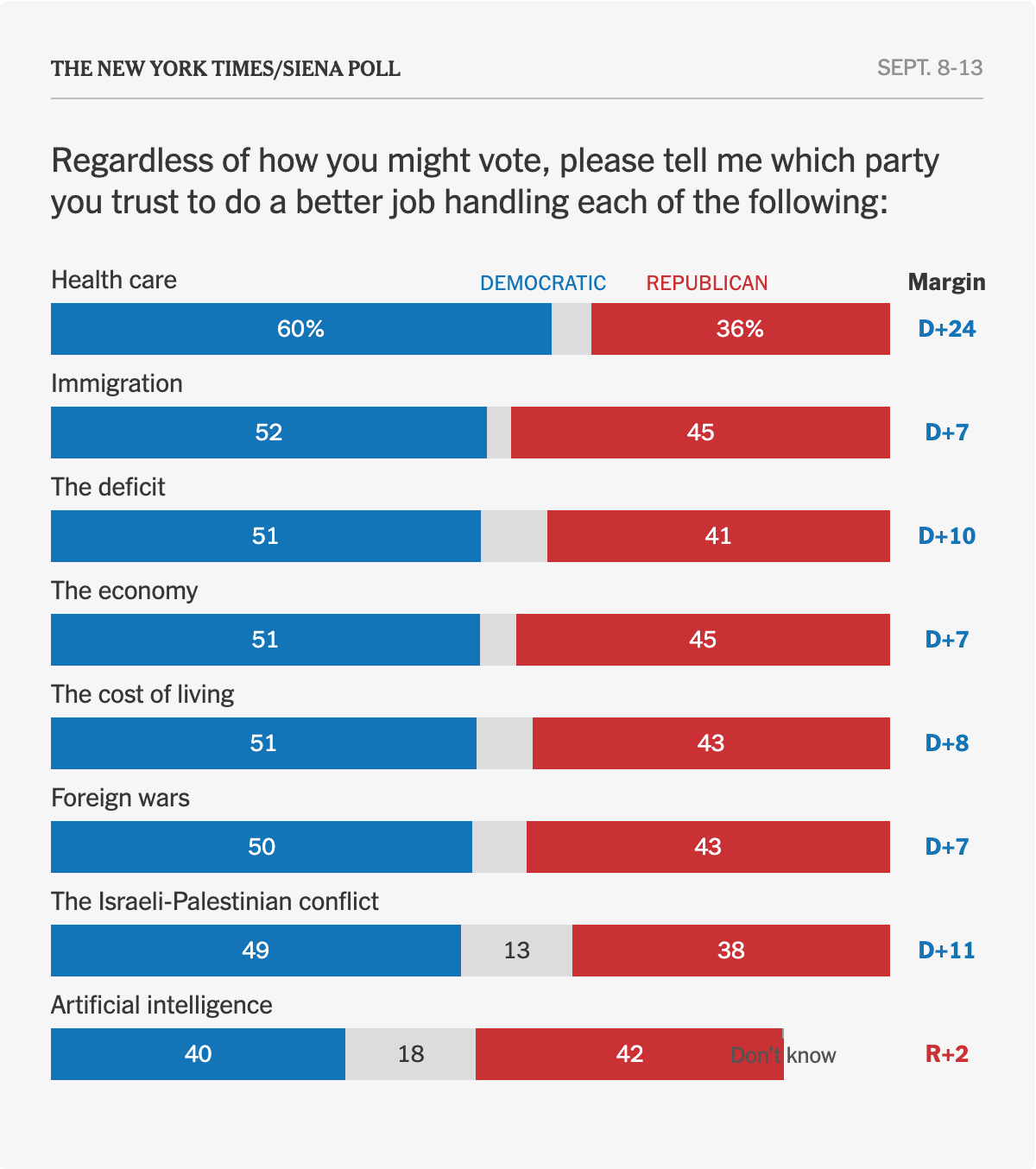
A different poll—this one of voters in swing districts—shows a somewhat different picture:
[The Democrats] perform better on the economy (+7), dealing with inflation (+8), lowering gas prices (+12), dealing with international trade and tariffs (+9) and addressing corruption in Washington (+7). Republicans have an advantage only on the issue of immigration (+5). And perhaps most notably, these voters trust Democrats to address policies related to data centers by a 10-point margin, 47% to 37%.
My advice is to prioritize posting about health care, which has long been the Democrats’ best issue, as well as the economy. Israel/Palestine is one of Democrats’ best issues, but I’m not sure what the American public even understands Democrats’ position on Israel/Palestine to be, so maybe be cautious about that one. I would post about immigration carefully: brutal ICE raids on sympathetic targets yes, open borders and “No One Is Illegal On Stolen Land” no. I have no idea how to interpret the findings about AI but probably if you’re inclined to post a lot about AI your top concern isn’t whether Democrats win in November.
I would recommend being positive about the Democrats. The Democrats are unpopular, just not as unpopular as Trump—which is a fragile position going into the midterms. In particular, when posting about corruption in Washington, I’d recommend listing off positive things about Democrats and not just the endless litany of Trump authoritarianism and crimes.
For the love of God, please save being weird and offputting about the culture war until December. There will be plenty of time for trans people to freak the mundanes when we don’t have an aspiring dictator in the White House.2 For now, make like the 2010s gay rights movement: if you’re going to talk about trans rights, be wholesome and sympathetic.
Of course, these are generalizations, and you know your own audience best. If most of your followers are libertarian, posting a lot about open borders and very little about healthcare might be exactly the right move. Maybe posting freaky shit about trans people will make you seem more credible to your leftist followers when you tell them to vote.
Some people might object that this is Lying. To be clear, I don’t mean that you should say things you don’t believe to be true. But your social media feed is not an endless stream of every thought that passes through your head. You exercise some curation—to respect other people’s privacy, to avoid oversharing, not to get dogpiled by people with poor reading comprehension, to be diplomatic about longstanding disagreements with your friends, not to cause problems for your employer or your jobhunting. All I’m saying is that you can additionally add the filter “does this make the Republicans more likely to win in November?”
I don’t mean to imply that everyone has to post about American electoral politics.3 Social media is (allegedly) supposed to be fun. If you’d rather talk about your cat, by all means post cat pictures. But if you’re going to be posting about American electoral politics anyway, you can do a remarkable amount of good by trying to persuade people.
Three times as many people get news from email newsletters as get news from AI chatbots! Substackers stay winning.
Again, totally fine to post about how vulvas are a male body part, everyone should be given puberty blockers, and we need to abolish gender—in your group chat, on your locked social media feed, or in December.
Thing of Things itself is unlikely to produce articles titled “Tariffs Make Prices Go Up” or “The Iran War: Not Just A Humanitarian Crisis, But Also A Reason Things Are Slightly More Expensive.” Unless you guys are really enthusiastic about the prospect, I guess.
I totally agree. I have a Facebook friend who only ever posts doom of various descriptions, always bad news from a defeatist perspective. The only thing he thinks will help is violent revolution, which he is not doing, and he thinks anybody who isn't screaming all the time about how bad it is is lacking in empathy and ethics.
Just can't really imagine his posts have ever done any good to anybody.
Whereas I genuinely did slowly change my point of view and my voting because of things I read online. The fact that people I knew believed these things was a reason for me to look into them more. A calm explanation of the rationale is much more convincing than a mocking meme or an angry meltdown.
I support this, but I would add one thing to consider: please try to speak and deliver your message in your own voice. You won't be persuasive if you come off sounding like the chatbot of a political consultant (unless that's how you usually speak).
I think people are more likely to respond to a heartfelt, personal appeal from a friend about why this election matters to them, rather than to a cold reciting of inflation statistics or whatever. The reason personal messaging is effective is precisely because of their connection to you specifically.
I don't think being strategic in the issues you bring up is actually dishonest, but if it is noticeably different from how you normally act, I can see why people would perceive it as dishonesty. IE: "This person does nothing but talk about shrimp welfare, but suddenly they say to vote democrat because of inflation worries?". In this case, I think a message of "I'm voting democrat for better animal policies, but even if you don't care about that, there's also X,Y, and Z" would be a better choice.