Some considerations on whether my job is evil

I.
On an average weekend, only 1 in 20 Americans go to a party.
This statistic boggles my mind. When I was fourteen, sitting alone in front of my desktop writing bad X-Men fanfiction, there was absolutely no way you could convince me that when I was an adult I would be in the top, like, quintile of adults for partygoing.
You see similar results across a bunch of different axes. According to data collected in the American Time Use Survey, social isolation has been increasing across several different metrics:
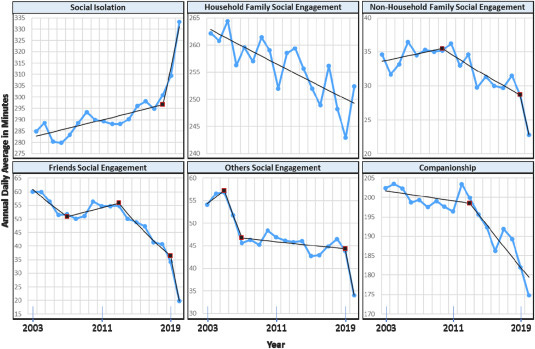
Note that these are all tracking time spent on in-person socialization, not time spent on digital socialization; probably some of the effect here is that people are texting in the group chat instead of hanging out in person.
This effect is primarily driven by people who were under age 26 in 2017—that is, the generation that grew up with the Internet. If you grew up before the Internet, you continue to do in-person socialization; if you grew up after, you consume Content.
To quote from the Surgeon General’s report in 2023:
Social networks are getting smaller, and levels of social participation are declining
distinct from whether individuals report that they are lonely. For example, objective
measures of social exposure obtained from 2003-2020 find that social isolation,
measured by the average time spent alone, increased from 2003 (285-minutes/day,
142.5-hours/month) to 2019 (309-minutes/day, 154.5-hours/month) and continued
to increase in 2020 (333-minutes/day, 166.5-hours/month). This represents an
increase of 24 hours per month spent alone. At the same time, social participation
across several types of relationships has steadily declined. For instance, the amount
of time respondents engaged with friends socially in-person decreased from 2003
(60-minutes/day, 30-hours/month) to 2020 (20-minutes/day, 10-hours/month).This represents a decrease of 20 hours per month spent engaging with friends.
This decline is starkest for young people ages 15 to 24. For this age group, time
spent in-person with friends has reduced by nearly 70% over almost two decades,
from roughly 150 minutes per day in 2003 to 40 minutes per day in 2020...Yet, almost half of Americans (49%) in 2021 reported having three or fewer close friends—only about a quarter (27%) reported the same in 1990...
Family size and marriage rates have been in steady decline for decades.
The percentage of Americans living alone has also increased decade-to-decade.
In 1960, single-person households accounted for only 13% of all U.S. households.70
In 2022, that number more than doubled, to 29% of all households.
And what are Americans doing with themselves instead? Well, mostly consuming various sorts of Content. The data backs this up: the average American watches 19 hours a week of television, a statistic that doesn’t include TikTok or social media. You can also observe this by looking at the experiences of yourself and your friends.
When I was a teenager, my household had one television, and Netflix still mostly sent you DVDs in the mail. If I wanted to watch a TV show, I had to sit down at a specific time and watch it, in a context in which it was easy for someone to join me. During commercials, I could talk about the show with the people I love. Many of my fondest teenage memories are of watching Grey’s Anatomy and Pushing Daisies with my mom and sister.
Now, I’m too busy to watch TV, but when my family members watch TV, they watch it on their separate laptops with headphones on. It takes active effort to watch it together. And streaming television isn’t naturally self-limiting the way that network TV was. You can always watch an episode of your favorite TV show. There is never nothing on.
I don’t watch TV. But I do have fifty Discord servers full of backscroll about every topic imaginable, from pictures of strangers’ dogs to the latest depredations of Donald Trump. Between Amazon, the Internet Archive, and Anna’s Archive, I have access to almost every book ever published, no matter how obscure the topic, within thirty seconds of it occurring to me that I might want this thing. Of this very moment I have 3,196 unread Substack posts and 500+ unread tabs that I definitely intend to get to one of these days.1 And let’s just not talk about all the many pictures of attractive women the Internet contains.
Several of my favorite people in the world live in my house, where I can talk to them at any time. And yet when I’m supposed to be talking to my partner Lindsey or my child Vasili, I often find my attention inexorably drawn to the Internet. I want to read what Cartoons Hate Her has to say about the rise of gentle parenting, I think to myself. I want to find out what happens in the next chapter of The Captive Prince. Let me backread all 1000 messages in that Discord conversation about financial abortion so I can give my irreplaceable take on the subject.
Is it unreasonable to think that my life would be better if it were possible for me to be bored? If sometimes I had nothing to do but talk to the people I love, or play with my kid, or pick up a hobby in the actual physical world?2
I don’t mean here to criticize all online socialization. I don’t think it really matters whether my book club is in person or over text or video call; similarly, I don’t think it’s worse to text my girlfriend than to visit her house.
Consuming Content doesn’t feel like a lonely life. You don’t have real friends, but we have given you such a glorious quantity of imaginary friends. Blorbo from your shows or your novels, your favorite podcast host or Substacker, the poaster you follow on Bluesky or even the person whose Discord channel you lurk in but never say anything.
These relationships are easy. Blorbo or the Bluesky poaster asks nothing of you: you don’t have to comfort them about their breakup or let them sleep on your couch or bring them a casserole when they have a new baby. You never have to worry that you’ve offended or annoyed them or that they secretly dislike you, because they have no idea who you are at all. If you don’t have anyone to talk to, you don’t have to go to parties and stand on your own and leave on your own and go home and cry and want to die; the algorithms will recommend you as many shows and influencers and posters as you can stand. You never even have to put on pants.
They’re easy, but they’re worse. Friends are a safety net for when something goes wrong in your life; the rest of the time, they are one of its greatest sources of joy. You’re supposed to love other people. That’s what humans are for.
II.
This set of opinions makes me nervous about the ethics of my career choice.
Even if I stop Substacking tomorrow, there will be an ocean of Content, far more Content than any human being could ever consume. But you guys are here, choosing to read my Substack, because you think it’s better than the other Content available to you. If I quit, at least some of you would decide that the Internet is boring today, and go offline to talk to your housemates or call your mom or practice the guitar or go on a hike or, you know, actually work at your jobs.3 Fundamentally, if I am worried that the ocean of Content is making the world worse, I should stop producing my own Content. This is an example of what Friend of the Blog Linch Zhang calls “the intermediate value theorem”.
This Substack is not, like, the worst content you could consume. I’m not making shortform video skits about how you shouldn’t date men with navy-blue sheets; I’m not posting on X or Bluesky to further destroy the life of today’s main character. I aim to provide informative, interesting posts that teach you about the world and make your life better. But it is possible—if somewhat more difficult—to waste your life on only the highest-quality Content: prestige television, classic novels, informative Substacks.
Unfortunately, the only thing I like more than money is writing, and if I wanted to get a different job they would look at my resume and go “so, I see that between 2019 and 2023 you had... a nervous breakdown? How did you learn job skills at that position?” So I am incentivized to come up with a rationalization to do what I want to do anyway.
I don’t think a good life involves zero consumption of Content. The arts and the sciences and the humanities are the noblest pursuits of humanity. A good life involves going to parties with friends (without your phone) and long walks in nature (without your phone); it also involves reading great fiction and learning about history. And at least some of what I write tells people about what they can do to make the world better. We aren’t suffering from a desperate shortage of helpful information about animal advocacy.
And, you know, at least sometimes I’m displacing you people scrolling X or Bluesky or TikTok.
The incentives of Substack push you to Always Be Blogging. People will stop paying you if you don’t post enough; as long as you put out fewer than, like, ten posts a week, they won’t stop paying you because you write too much. Substack pushes you to write more poorly researched posts, low-effort hot takes, beefs with other Substackers, and most of all self-help.4
But as a wise man once said, “it’s not the Incentives, it’s you.”
I have become increasingly convinced—particularly after Inkhaven—that I want to write fewer, higher-effort posts. I will put the same amount of effort into writing that I always did. But instead of five posts, I’ll write one. Instead of reviewing a single book or paper, I’ll try to synthesize multiple sources. I’ll send my posts to experts and people whose judgment I trust to get feedback and avoid glaring mistakes. I’ll avoid writing the kind of posts I can write three of in an afternoon.5
(I’m also going to write more fiction, which is the highest-effort kind of post for me, and relatedly something I don’t write as often as I endorse.)
The Slow Food movement can be criticized, but I understand the impulse towards food made with recognizable ingredients, eaten with mindful attention and good conversation. Similarly, I want to create “slow content”: content I put time and effort into, that rewards careful reading rather than skimming with Bluesky open in the other tab.
I’m going to try to hold myself to the Housemate Test: I won’t hit “publish” unless I think that, for my average subscriber, reading my post is a better thing to do with your time than having an ordinary fifteen-minute conversation with a housemate.
I’ll admit to being a bit nervous about this decision. You can ignore the incentives, but the incentives won’t ignore you. It’s possible I’ll lose half my subscribers and slink back towards a life of Substack beefs and dating discourse. But I’m going to attempt the experiment, and I hope you join me.
My unread tabs are more under control, not because I am better at keeping on top of my unreads, but because I keep breaking my laptop and losing all the links I’d saved to read later.
I do bake and cook a lot, but I have to bribe myself with podcasts to do them.
I see you, people who open this email at 9 am on a workday.
You people have an insane appetite for self-help.
Several times during Inkhaven, I was stuck for posts and browsed Substack Notes to see who had a bad take.
I think your post in general makes sense, but was this data collected in actual 2020? Like, THE 2020?
Because if it was, and looking at the graphs that appears to be the case, the researchers should probably check if there's been any recovery since...
Interesting. I stopped writing for my blog because I thought writing would be worth it only if my posts would be, on average, better than the post my readers would otherwise read. I never thought about comparing it to what readers might do instead.
I don’t think it’s a completely fair comparison; reading Substack while commuting to a job can’t be replaced with a nature walk. Not all time can be reallocated to socializing. Still, it’s an interesting point.