
[This is a guest post from Mia of Hemlock Leaves.]
You can probably picture a baby kangaroo, with its little furry head peeking out of a pouch on its mother’s belly.
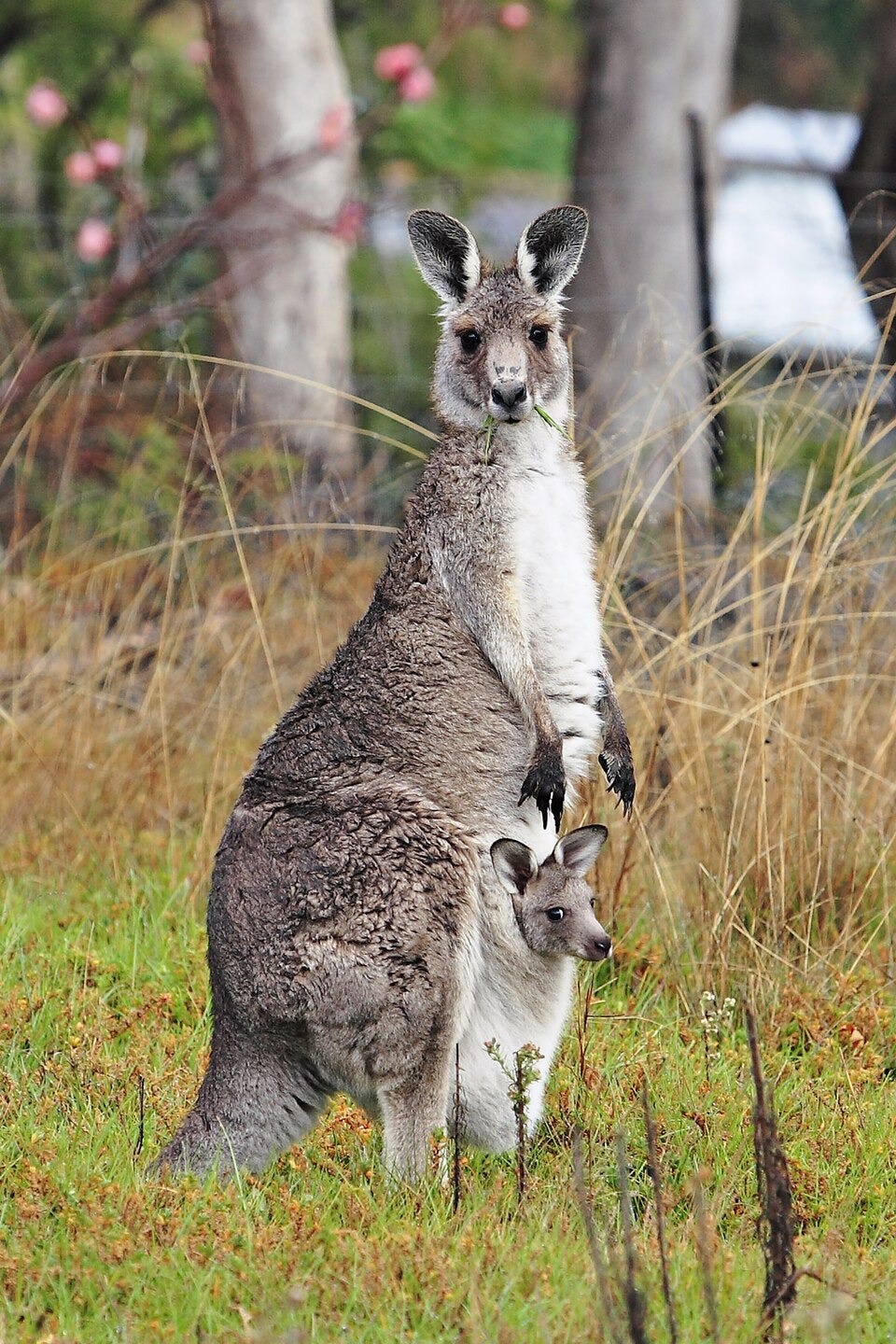
That’s not what a newborn kangaroo looks like.
Kangaroos have very short pregnancies which end as soon as their fetus has the absolute bare minimum functionality necessary to crawl from the birth canal to the pouch and start nursing. So this is what a kangaroo newborn looks like.
For people who don’t want to click on the (gross) link: a newborn kangaroo is a slimy pink shapeless blob, about an inch long, with bones, blood vessels, and organs visible through its nearly transparent skin. Its most recognizable feature is the relatively well-developed front legs, which it uses to grasp its mother’s fur when it climbs up to her pouch.
A newborn kangaroo doesn’t have hind legs yet. Its eyes and ears don’t work yet, but that’s fine, because it can navigate to the pouch by smell. It’s too tiny and hairless to maintain a stable body temperature, but that’s also fine, because its mother will keep the pouch warm. Its jaw muscles aren’t strong enough to hang on to its mother’s nipple, but again, totally fine, because the nipple will swell up as soon as it’s in the baby’s mouth and stay swollen for the next few months, making it physically impossible for the baby to detach. Its jaw muscles also aren’t strong enough to actually suck milk from the nipple, but everything is fine, okay, it’s fine, because the nipple will helpfully drip milk down its throat.
Kangaroos are marsupials. All of the over 300 species of marsupials—including koalas, possums, Tasmanian devils, and quokkas—follow the same reproductive playbook: a quick pregnancy produces a still-very-much-fetal baby, which needs to spend months developing in the pouch. Kangaroo newborns are actually pretty self-sufficient by marsupial standards. Some marsupial newborns don’t even have fully functional lungs yet, so they do most of their breathing through their skin.1
But most mammals aren’t like this. Most mammals—including humans, cats, zebras, pangolins, naked mole rats and over 6,000 more species—are what’s called “eutherians.” We have long pregnancies that produce large infants with working limbs and internal organs.
We eutherians diverged from the marsupials about 180 million years ago, before there were birds or flowers. Early marsupials lived all over the world, though they’re now concentrated in Australia, New Guinea, and South America.
We have some even more distant mammalian cousins: monotremes. Biologists don’t like it when you call monotremes primitive, but they do have a distinct vibe of being halfway between reptile and mammal. They run a bit colder than other mammals, in the high eighties Fahrenheit. They lay eggs. And although they do produce milk for their offspring, they haven’t totally figured out the nipple thing. Instead, monotreme mothers just secrete milk from glands on their skin—basically sweating it out—and let it pool on their bellies for their babies to lap up.
Monotremes historically lived in Australia, South America, and probably Antarctica. But they’ve been crowded out by marsupials and eutherians on those continents. Now there are just five species of monotremes left—the platypus and four types of echidna—in Australia and New Guinea.
So there are three mammalian lineages that have been independently evolving for hundreds of millions of years. Monotremes and marsupials are still recognizably mammals—they get pregnant and they feed their babies milk—but they do it in a very different way than we do. I’m going to talk about how these funhouse-mirror mammals work: what adaptations they need, what tradeoffs they face, what evolutionary doors have been opened or closed by their style of reproduction, why there are so few of them left. But first we need to talk about…
The plumbing
So that you’ll fully appreciate the madness that comes next, here’s a brief rundown on what a normal mammalian female reproductive system looks like.
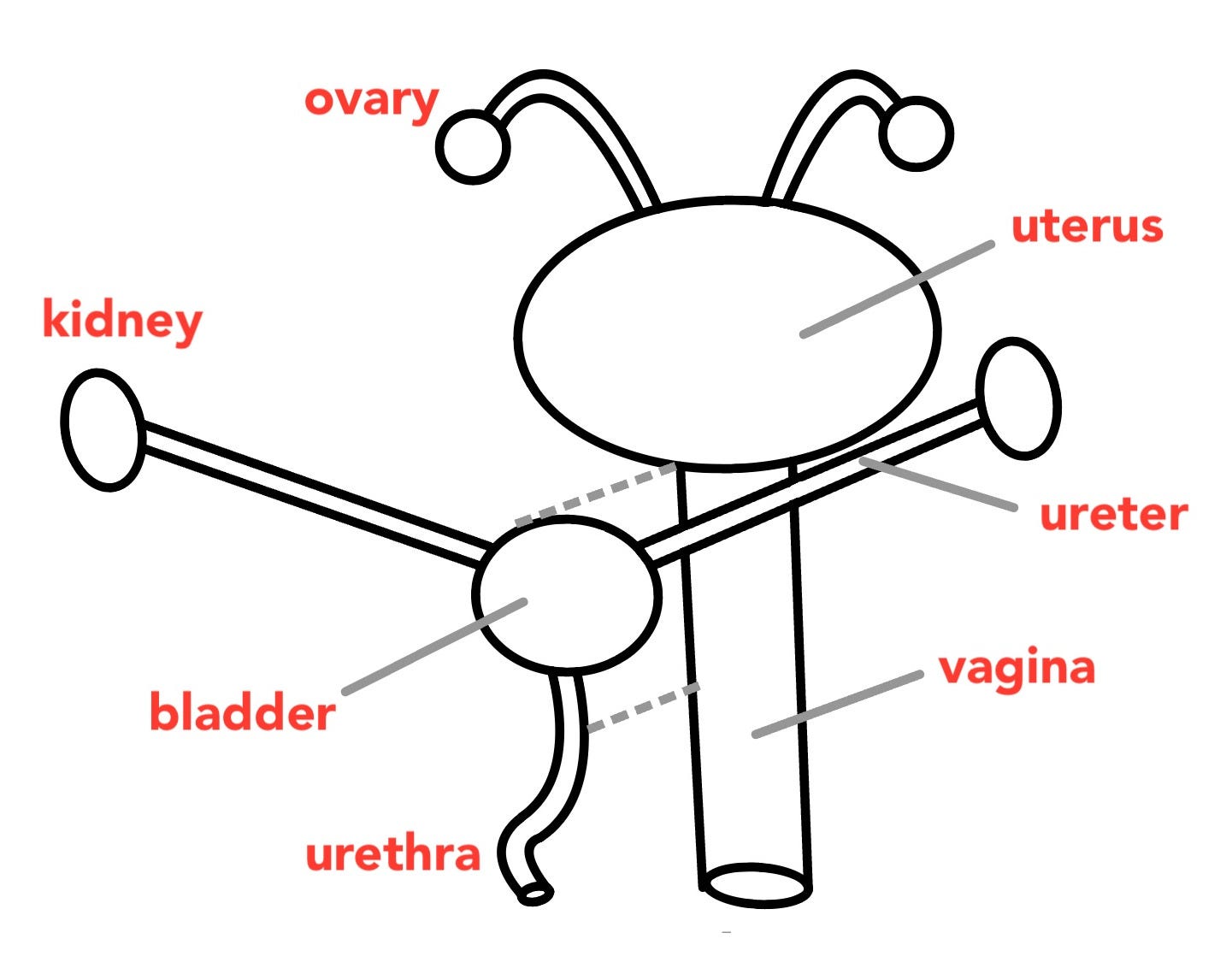
So basically: two ovaries feed into a uterus. Sperm comes up and babies go down from the uterus through the vagina. Next to all that, but separate, is the urinary system. Pee goes down from the kidneys through the ureters to the bladder and then comes out through the urethra.
Okay, now here’s what a female marsupial looks like inside:
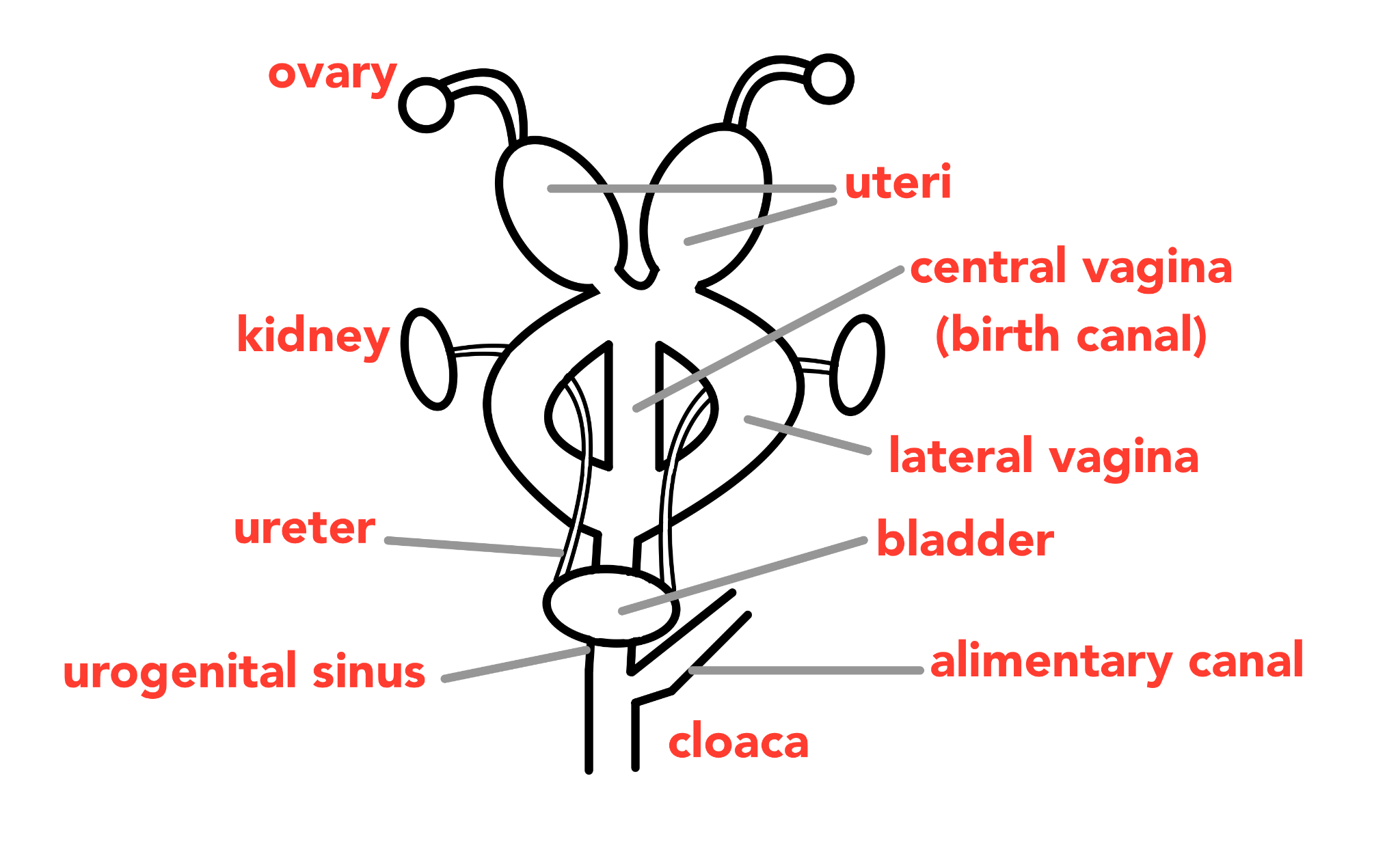
So they have three separate parallel vaginas, which meet back up at the top and hook up to the two (!) uteruses.
Why do you need three vaginas? Well, you need two side vaginas to carry sperm up to each uterus. But babies don’t come down through those vaginas. They come down through the third vagina in the middle.
(In some species, females are born with just the two side vaginas. When they’re ready to give birth, they grow the third vagina. The third vagina will stick around long enough to deliver the baby and then close back up until next time.)
Since each side vagina leads to a different uterus, males get the best chance of getting a baby if they can ejaculate into both vaginas at once. So some marsupials have forked penises.
(A lot of the same genes that build penises in male fetuses get reused for building clitorises in female fetuses. So, yes, some female marsupials have forked clitorises.)
The other weird thing with the marsupial genital situation is that the urinary system is tangled up with the reproductive system. The ureters go through the gaps between the side vaginas and the central vagina, and then they link back up with the bladder. From the bladder, pee goes out into the cloaca—which is also the entrance for the three vaginas. And the cloaca also hooks up to the digestive system. If you’re wondering what sorts of exciting infections you get if you have one exit for sex, pee, and shit—well, yeah, vets have to deal with this constantly.
But onwards! There are even jankier reproductive systems still ahead of us!
Female monotremes do all their business through one long tube:
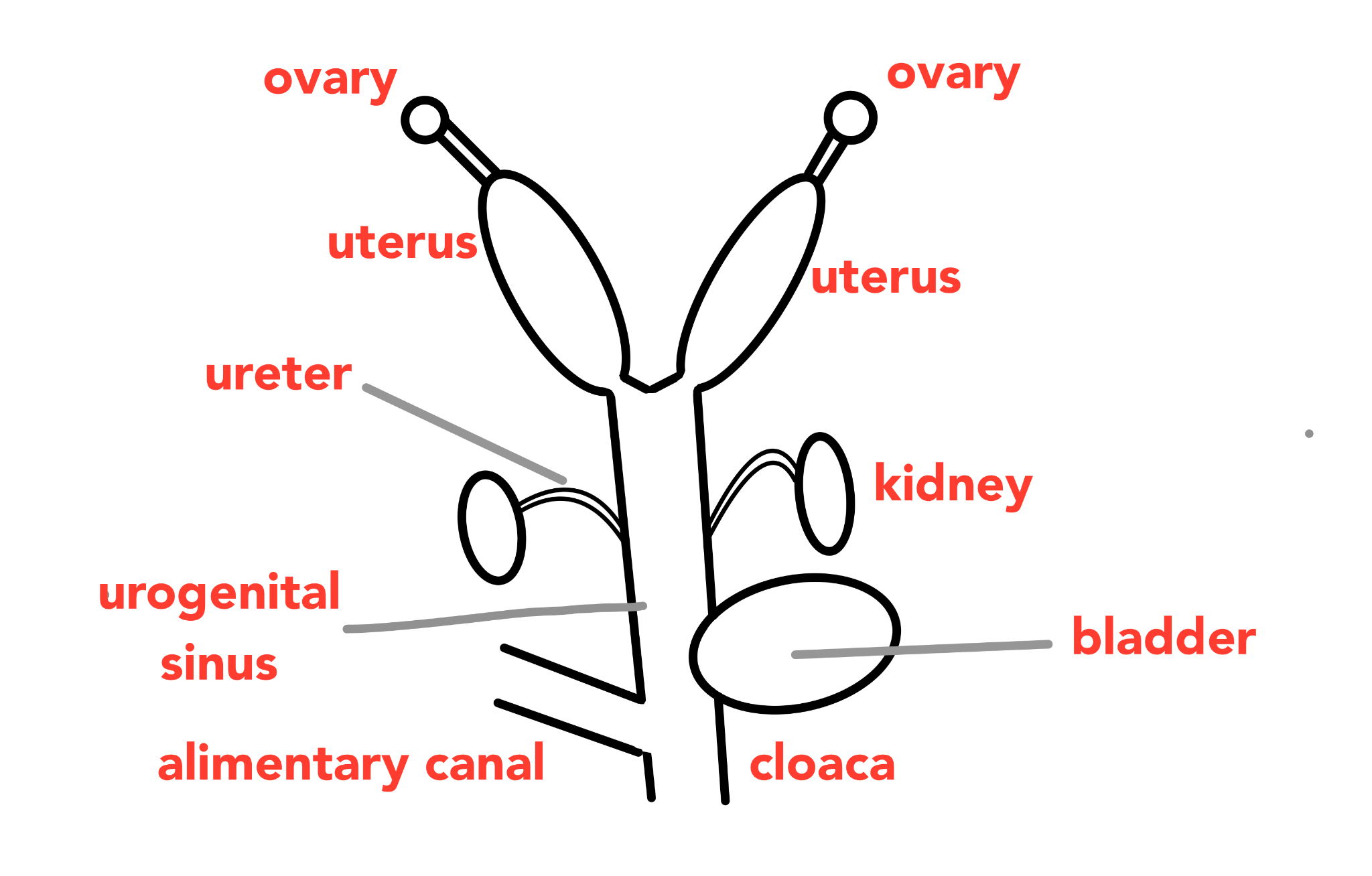
Monotremes avoid tangling up their urinary and reproductive systems by having a very simple urinary system. Very very simple. Maybe too simple?
I spent a long time struggling to understand how exactly their urinary system worked. All the diagrams I saw showed both kidneys and a bladder but no kidney-to-bladder connection. Instead, the kidneys hooked up to the cloaca and the bladder also hooked up to the cloaca, at a different spot. But if pee goes directly from the kidney into the cloaca, then why doesn’t it immediately fall out of the cloaca?
As best as I can tell, the answer is that monotremes clench the muscles of their cloaca to hold the pee in and maneuver it up into the bladder until they’re ready to pee. So janky.
Male monotremes pee and poop through their cloacas, just like the females. They also store their penises inside their cloacas when they aren’t using them. When a male monotreme gets an erection, his penis will push out through his cloaca (probably picking up some of his fecal bacteria on the way out), then enter his partner’s cloaca (picking up some of her fecal bacteria), and then carry all that up her reproductive tract.
(Unlike with marsupials, I haven’t found any veterinary texts confirming my guess, but I gotta imagine that the UTI rate is devastating.)
In normal mammals, sperm travels from the testicles through a tube called the vas deferens that connects to the urethra, which carries the sperm out of the penis. Monotremes make the insane (but admittedly on-brand) choice of having the vas deferens drop semen into the cloaca, aka the General Purpose Pipe for Everything, and hope it somehow gets into the urethra.
I say “somehow” because we literally don’t know how the semen gets to the urethra, as opposed to going up one of the many other branches of the cloaca or just falling out the bottom of the cloaca. We have some educated guesses. Maybe ejaculations involve the cloaca muscles twisting to maneuver the semen into the urethra, in the same way that they get pee into the bladder? Maybe the penis physically blocks the cloaca exit to keep the semen in the cloaca and then the semen sloshes around in there until it gets to the urethra?
Fenelon et al. (2021) have lovingly documented the magnificently bizarre echidna penis, which divides into four separate heads (image here). Given that female echidnas only have two uteruses, four penises may seem excessive. And, in fact, only two of the four heads get used at a time. The extra two won’t even get erect.
It’s not totally clear why you’d evolve twice as much penis as you need and then only use half each time.
Males do switch off which half of their penis they use each time. Maybe this helps them have sex more frequently? That’s Fenelon et al.’s theory at any rate.
The other odd thing about echidna penises is the shape of the urethra. Most mammals just have a single straight urethra. Marsupials with forked penises have a urethra that forks once. Echidna urethras branch into four forks and then, near the tips, each fork branches again into dozens of tiny channels that spray out the semen like a sprinkler. I have no idea why this happens.
I couldn’t find much on the platypus penis, but based on pictures it appears to be bifurcated and also to have a lot of spikes around the tips. Spikes are surprisingly common in mammal penises,2 but the fork is a little strange given that female platypuses actually only have one working uterus. (The other uterus is vestigial.) Maybe the second fork is also vestigial? Or maybe platypus males, like their echidna cousins, alternate which side of their penis they use for increased stamina?
Pregnancy and lactation
I’ll again start with a refresher on how eutherian pregnancies work before I move on to the funhouse mirror versions. Sex happens: the male inserts his single-pronged penis into his mate’s one (1) vagina, deposits some sperm somewhere in her reproductive tract, and an egg gets fertilized. A week or so later, the embryo will attach into the side of the uterus and grow a placenta.
The placenta’s job is to pull food and oxygen from the mother’s blood and send them to the fetus through the umbilical cord. To do this, the placenta will have to get real cozy with the inside of the uterus. In most species, it presses right up against the blood vessels in what biologists charmingly call capillary intimacy. The intimacy gets even more intense in a few species, where the mother’s cells actually fuse with the placenta’s cells so that there’s a layer of cells with two nuclei and two sets of DNA, one from the mother and one from the baby.
Close contact between mother and fetus makes resource transfer very efficient. But it also means that eutherians have had to develop a lot of special adaptations to keep the mother’s immune system from freaking out about the rapidly growing, genetically distinct entity slurping nutrients from her bloodstream (you know, the exact threat vector that immune systems exist to defend against).
Monotreme mothers, in contrast, maintain a respectful distance from their unborn offspring. The embryo never attaches to the side of the uterus and instead floats freely for the whole pregnancy. To sustain their embryos, mothers will release nutrient-rich fluids into the womb, which is basically the equivalent of flinging handfuls of food in every direction in the hope that some of it will happen to land in your baby’s mouth. Consequently, monotreme embryos grow very slowly. After two weeks, the mother calls it a day, covers up the egg with a leathery eggshell, and lays it.
Marsupials do something in between. Marsupial fetuses spend most of the pregnancy floating in a bath of nutrient secretions, just like monotremes. Then, with about a week to go, the fetus gets a nagging feeling that maybe it’s forgetting something and belatedly jams its placenta into the side of the uterus. Even then, the implantation is pretty half-hearted. Most marsupial placentas don’t ever achieve capillary intimacy, and this probably limits how fast they can draw in nutrients from their mother. After a brief period of very daintily sipping from its mother’s bloodstream, the marsupial fetus is evicted. At this point, it’s the developmental equivalent of an eight- to ten-week human embryo.
Now, part of why marsupial fetuses are so underdeveloped is that marsupial pregnancies are super short. Eutherians have pregnancies that range from sixteen days to almost two years, but marsupial pregnancies cap out at 38 days, short enough to fit snugly within the mother’s ovulation cycle.
But a few eutherians have pregnancies just as short as the marsupials’—mostly very small eutherians.3 These eutherian mothers are still able to crank out way more baby in the same short pregnancy, because they let their developing fetuses implant sooner and (probably) suck in nutrients at a faster rate once implanted. Small marsupial mothers have newborns that are less than 0.2% of the mother’s mass, with litter sizes rarely exceeding 1% of maternal mass. Small eutherians routinely have babies that are 2-3% of the mother’s mass, with litters totaling a frankly horrifying 20% of maternal mass.
All this is to say: pregnancy is a very different animal for marsupial and eutherian mothers. Marsupial mothers basically don’t consume energy at a noticeably faster rate during pregnancy. They don’t get a baby bump. Some marsupial mothers reportedly give birth without appearing to notice.
Pregnancy for marsupials is so insanely cheap that some of them routinely birth way more babies than they can possibly nurse. Tasmanian devils are the worst offenders. Mothers give birth to twenty to thirty babies at a time. They only have four nipples in their pouch, and, remember, when a newborn marsupial latches on, it won’t let go for weeks. Tasmanian devil moms are literally physically incapable of caring for more than 20% of the babies they carry.
So, as soon as they come out of their mom’s cloaca, newborn devils have to race to claim a nipple before their siblings. The losers will dehydrate, freeze, or starve to death.

Marsupial moms make up for the short, low-commitment pregnancy with an extra long nursing period. You can see the difference by comparing matched pairs of marsupials and eutherians of about the same size occupying roughly the same niche. For example, Thomson’s gazelle (a eutherian) and the common wallaroo (a marsupial) are both mid-sized open-country grazers.4 The gazelle is pregnant for five months, but only nurses its baby for two months. The wallaroo zips through its pregnancy in a month, and then learns that it’s on the hook for a full year of nursing.
Because of these long lactation periods, marsupials tend to spend longer on each kid from conception to weaning, usually about 50% longer.
And marsupial babies change a bunch during lactation, so the content of milk also has to change. The nutritional needs an adorable furry baby that can move its limbs on purpose are different from the nutritional needs of a slimy thrashing fetus with creepy bulging balls of black tissue where the eyes should be.5 Early milk tends to be waterier and easy to digest. It contains a lot of iron, because marsupial newborns don’t have a liver capable of storing iron and so need their supply constantly topped off. Later milk has more concentrated fats and proteins to support a bigger and more active baby with a mature digestive tract.
One sidebar on pregnancy lengths: I said that marsupial pregnancies never last more than 38 days. That was a bit of a fib. There are never more than 38 active days of pregnancy. But some marsupials can pause their pregnancies a few days in and then unpause them weeks or months later.
Red kangaroos do this a lot. A day or two after a red kangaroo gives birth, she’ll mate again and get pregnant in whichever uterus didn’t just host a baby. But she won’t be ready to birth another baby right away, since her pouch will still be occupied for about seven months. So she’ll freeze her fetus after about two days of growth. Once her older child has left the pouch, she allows the fetus to resume growing and gives birth to it 31 days later. So red kangaroo pregnancies last anywhere from 33 days to 252 days.
Healthy female red kangaroos are almost constantly pregnant and it’s pretty common to find them caring for three rounds of offspring: a mature joey living outside the pouch but still nursing, a fetal joey living inside the pouch, and a suspended embryo waiting for the pouch to free up. One nipple will produce thin watery milk for the younger joey and another nipple will produce fattier milk for the older one.
Who is the best mammal?
Marsupials have a short, easy pregnancy followed by a long nursing period, and eutherians have a long, tough pregnancy followed by a short nursing period. So, who’s doing it right?
It’s tempting to say that it’s us. We’ve been thoroughly kicking marsupials’ asses for the last 60 million years or so. There are 6000 extant eutherian species and just 300 marsupial species. Eutherian mammals live on every continent, while marsupials are mostly restricted to Australia and South America. These are both fairly isolated continents—Australia is an island, and South America wasn’t connected to North America until pretty recently. And whenever eutherians have managed to cross over to Australia and South America, they’ve done pretty well for themselves:
About 30 million years ago, some rodents and monkeys floated across the Atlantic from Africa to South America on natural “rafts” made of vegetation.6 And just when the killer capybara-and-capuchin combo arrived, there was a big decline in marsupial species diversity in South America.
Around 3 million years ago, the Panama Isthmus rose up out of the ocean to connect the Americas, kicking off the Great American Biotic Interchange (GABI) as species crossed the land bridge. Before the exchange, all North American mammals were eutherians, while South America had lots of marsupials. This is basically the purest head-to-head match between the two clades that we’ve gotten, with each having the opportunity to spread into the other’s territory. And the result is...almost half of modern South American mammals are descended from North Americans who crossed over during GABI, but only about 10% of North American mammals are descended from South American species. And a lot of the successful South American immigrants were actually eutherian rodents—the descendants of the guys who floated over from Africa.
Around 3000 years ago, humans brought dingoes to Australia. At about that time, Tasmanian devils and dog-like marsupials called thylacines went extinct on mainland Australia (but stuck around on Tasmania, where there were no dingoes).
Each of these cases gets nitpicked a lot. Maybe climate change caused the decline in South American marsupials 30 million years ago? Maybe South American species disproportionately went extinct during GABI because they hadn’t coevolved with the fiercer North American carnivores? Maybe people told the thylacines that they were worse boys than the dingoes, and the thylacines all ran away to Tasmania in despair?7
None of the cases are individually clear-cut, but the overall pattern is pretty suspicious. And there’s not many examples of marsupials making it big in previously-eutherian territory—the only example I know of are the possums, who are doing pretty well in Central and North America.
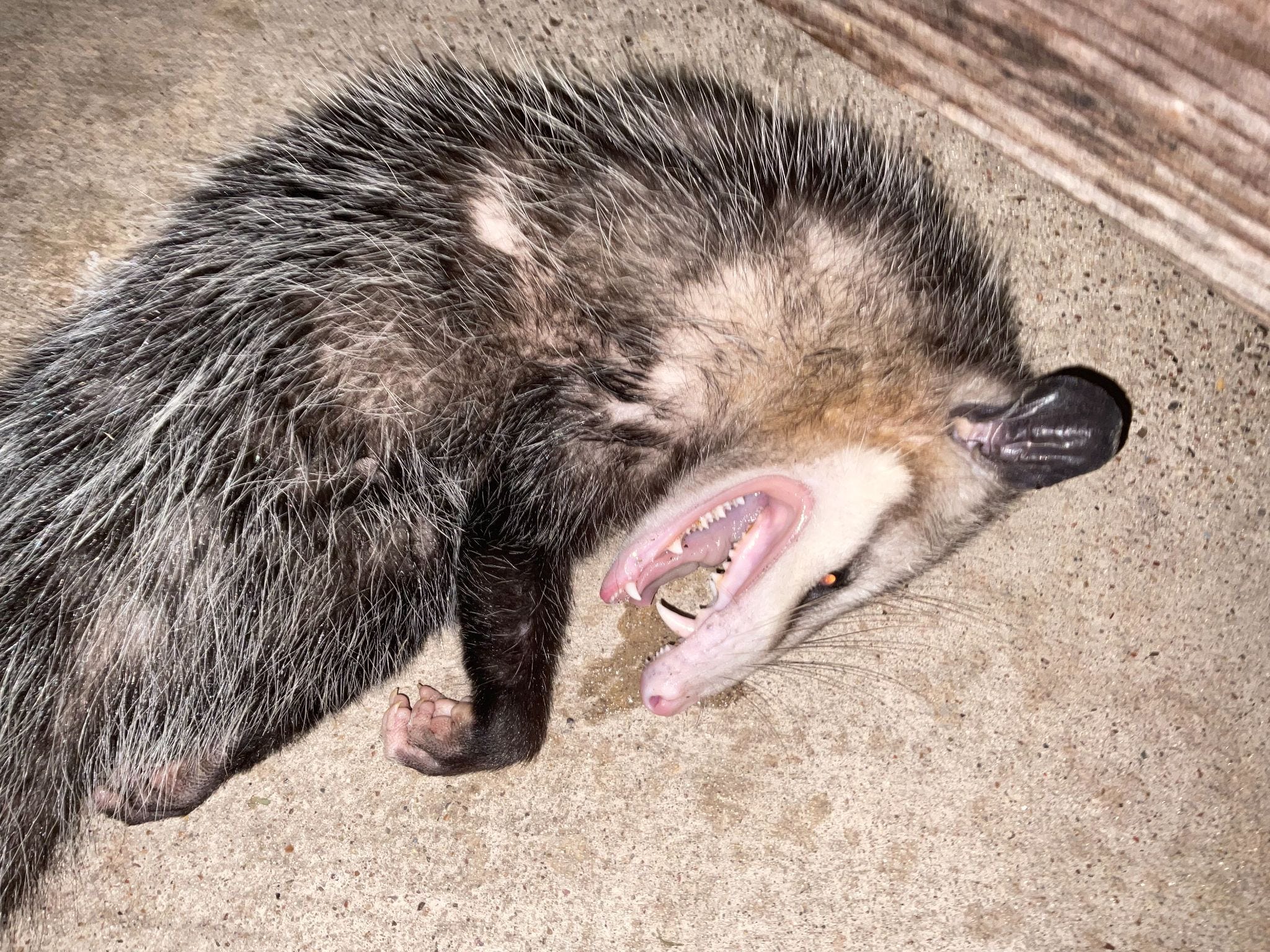
There was a lot of academic discourse in the seventies and eighties about what happened. Many researchers pushed back on the frame that one mode of reproduction was superior to the other. Maybe eutherians and marsupials are just pursuing different, equally valid reproductive strategies, and the eutherians just got lucky or something.
I tend to be more sympathetic to the “eutherians are better” position. But to give the marsupials their fair shake, I’ll start with the benefits of the marsupial form of reproduction. We’ve already covered some of these: pregnancy is very easy for marsupials and birth is even easier.
Another possible advantage for marsupials is pelvic shape. Eutherians tend to have pretty sexually dimorphic pelvises—think about how human women tend to have wider hips than human men. This is because female eutherians need to be able to fit an entire baby skull through their pelvis. Male eutherians don’t have this constraint. They have whatever pelvis shape is best for running around, which usually means narrower hips. Since female marsupials give birth to teeny-tiny babies, they don’t need anything beyond a standard-width pelvis.
Marsupials might also have an easier time suddenly terminating reproductive effort, or, in less clinical terms, dumping a baby out of the pouch and leaving it to die. Marsupials terminate reproductive effort if the baby looks unhealthy or if they’re running out of food. Eutherians can and do miscarry fetuses under these circumstances, but having a late-term miscarriage is probably a lot harder on the mother than quickly turning her pouch inside out.
The most darkly funny version of this is the way that startled kangaroo and quokka mothers will sometimes dump their babies out of their pouch and sprint away. Not only will the mother run away faster if she doesn’t have to carry her pouchling, the abandoned baby is a softer target that distracts a potential predator while the mother gets a head start! I, uh, certainly hope that pregnant eutherians can’t replicate this strategy.
But there’s one area where eutherians have an advantage, and it’s an important one: how fast populations can grow.
Remember how eutherians spend less total time than marsupials on each batch of babies? This means that eutherian mothers can churn out litters at a faster rate. It also means that there’s less time between when a baby is born and when it’s ready to have babies of its own. Both of these contribute to faster population growth.
Now, marsupials can somewhat compensate for this by having more babies at a time. But—empirically8—the max growth rate of marsupial populations tends to be smaller than the max growth rate for eutherians.
Obviously, populations aren’t growing at their maximum rate most of the time. But the ceiling still matters. Populations that are capable of growing really fast can bounce back more easily from a sudden shock and are better at quickly expanding into new territory.
All the marsupial advantages—easy births, narrow hips, casual child abandonment—are real. But when a land bridge rises or a fresh continent appears, it’s pretty hard to beat the ability to make more baby even faster.
Many marsupials
Here’s one last hypothesis about why there are fewer marsupial species. Remember, right after being born, marsupials need to be able to climb up their mother’s stomach and crawl into the pouch. This means that they have to be born with strong front legs capable of gripping and climbing. And maybe—the hypothesis goes—that requirement constrains the possible set of front legs they can have once they’re adults. It’s tough to grow a climbing claw and then regrow it into a wing or a flipper or a hoof. Maybe that’s why we don’t have marsupial bats or seals or horses.
I don’t really buy this one. For one thing, as Andrew Cockburn points out, not all marsupial newborns actually climb into the pouch. Newborn bandicoots dangle on their umbilical cord until their mother manages to swing them onto a nipple, which is quite an image. Tasmanian devils are apparently “ejected” directly from their mother’s cloaca into her pouch (also quite an image).9
And the shape of the limb at birth doesn’t fully determine the shape in adulthood. Some marsupials do lose the climbing claws and grow totally new structures.
Yes, it’s true that there aren’t any marsupial bats or seals or horses. But marsupials have managed to diversify quite a lot—here are a few examples.
Let’s start with my favorite: the Tasmanian devils. “Tasmanian devil” is actually one of the more flattering names that have been given to the species. (Other names include “Beelzebub’s pup” and the early species name Sarcophilus satanicus, which is neo-Latin for “Satanic flesh-lover.”) They have a bit of a reputation for viciousness, probably because of their scary-sounding howls and all the cannibalism10 and maybe also the thing where sometimes ranchers will come out in the morning to find the skeleton of a cow, picked clean to the bone, with a few devils in a food coma napping inside the rib cage.11
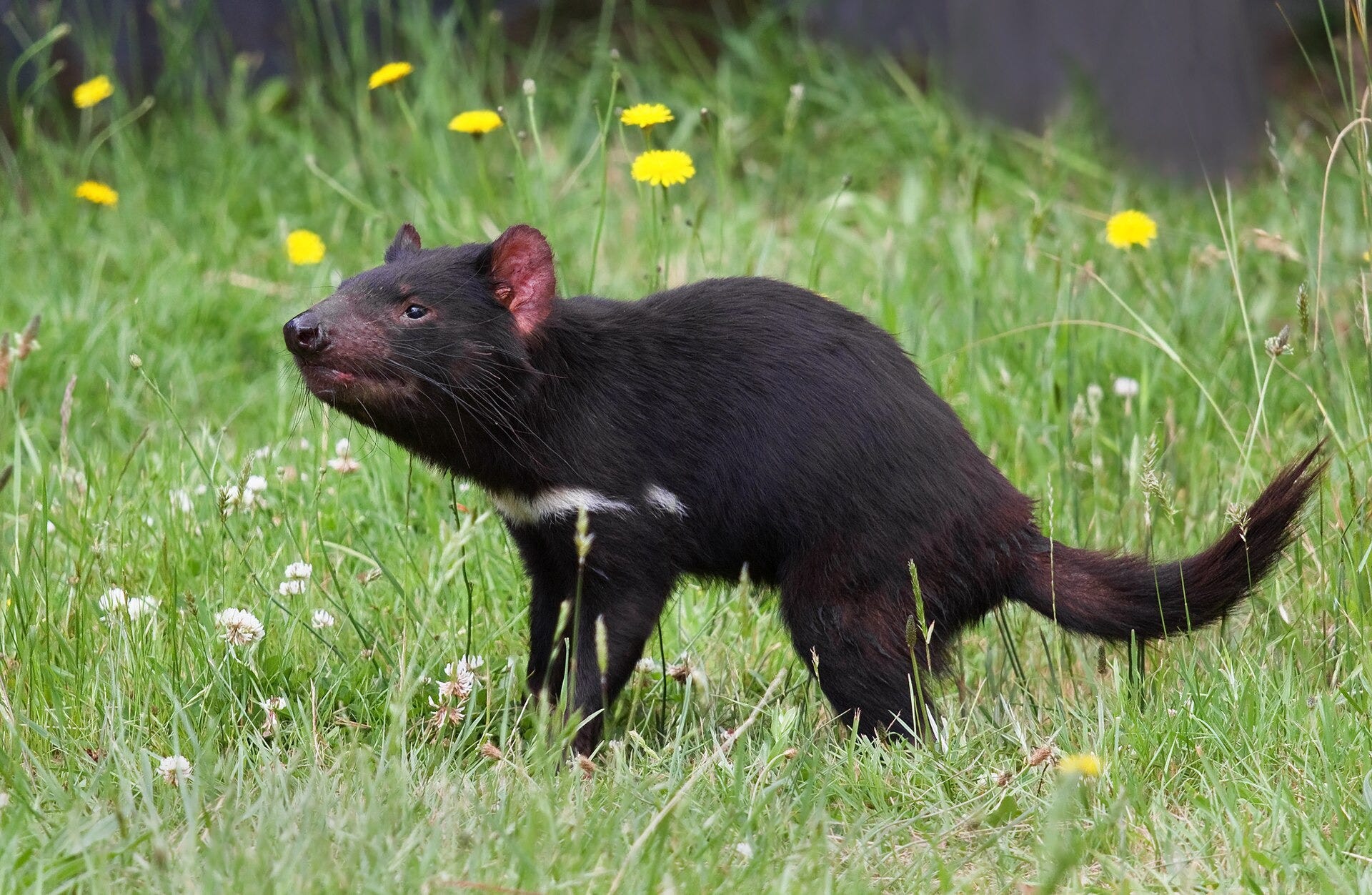
Tasmanian devils are the largest surviving marsupial carnivores, at about 25 pounds. You can think of them as basically marsupial hyenas—good hunters and excellent scavengers. They have extremely powerful jaws, which can bite down as hard as a dog four times their size. They mostly use their jaws to crack open bones, but they’ve also been known to chew through steel wires. They eat a lot, both in the sense that they can wolf down 40% of their body weight in a sitting, and in the sense that they aren’t at all picky. Objects that have been found in devil droppings include: part of a woolen sock, a wallaby foot with bit of snare wire still attached, a pet collar, twenty-seven echidna quills, stock ear tags, the head of a tiger snake, half a pencil, an owl foot, a cigarette butt, and bits of tinfoil, plastic, styrofoam, and steel wool.12
Marsupial moles, on the other hand, live underground in the Australian desert. They’re great diggers with big front claws. The sandy desert soil is too loose to dig permanent burrows, so marsupial moles “swim” underground, digging a temporary tunnel in front of them and letting it collapse behind them (marsupial mole mothers have backward-facing pouches, so that the pouch doesn’t get full of sand as the mother tunnels around). They don’t need to come up to breathe, since their slow metabolism lets them get by on air trapped between grains of sand.
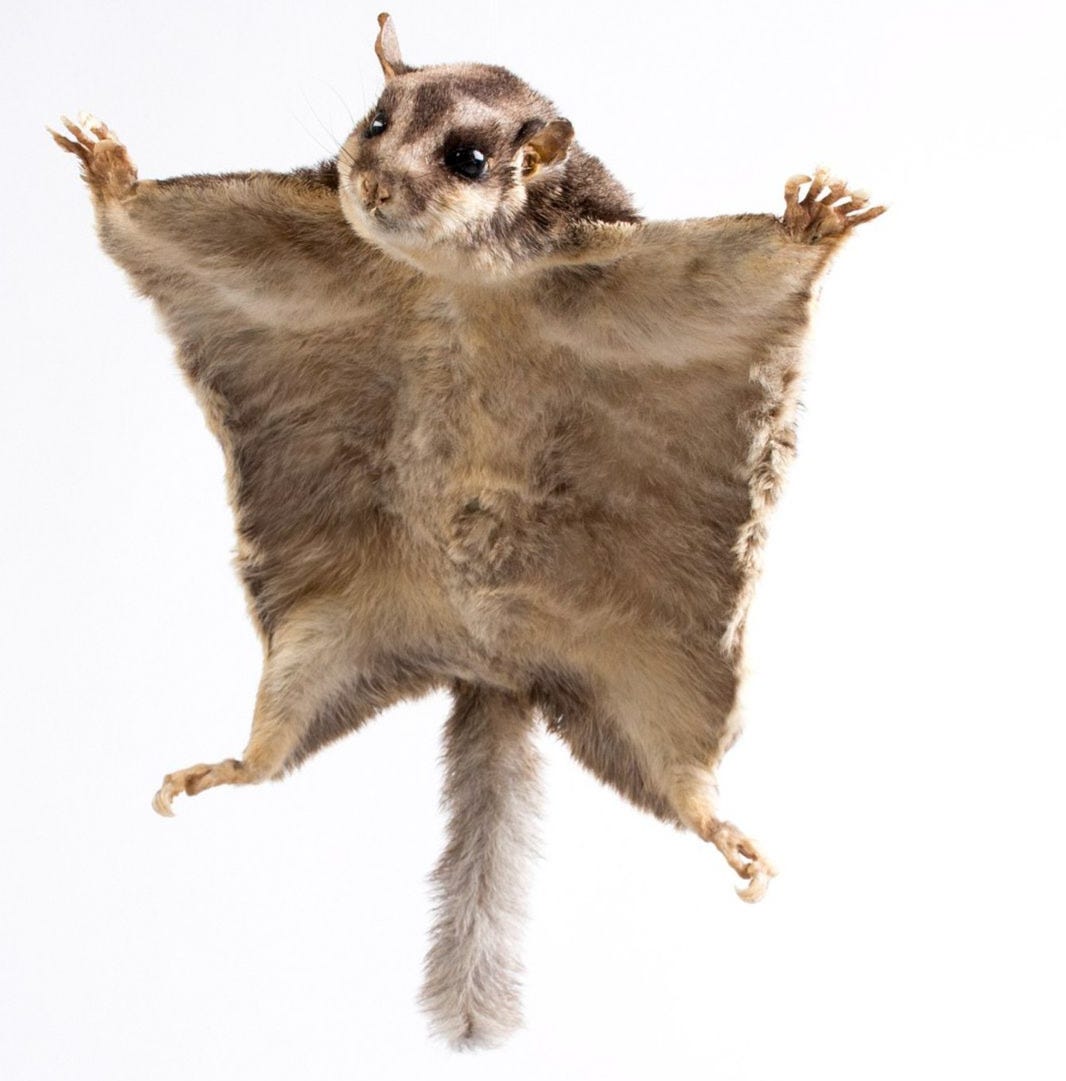
No marsupial has evolved wings, but sugar gliders have gotten closest. They have wide “flying” membranes between their legs which let them glide through the air from tree to tree—as many as 150 horizontal feet in a single glide!
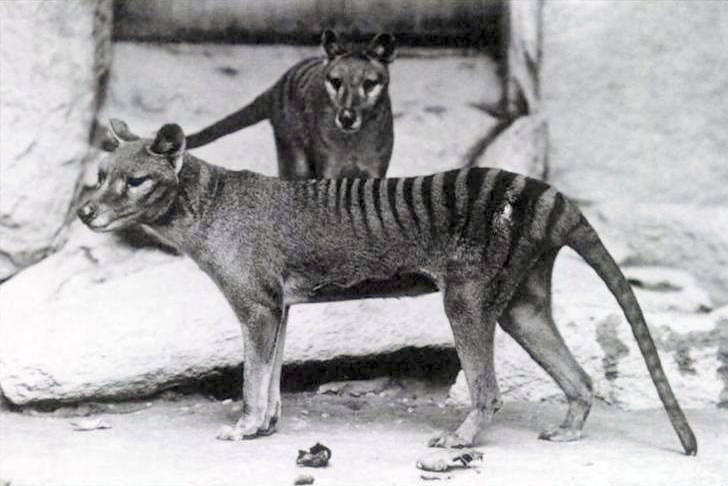
I’ve mentioned the uncannily canine marsupials called thylacines, which had long narrow snouts and pointed ears (although Science has investigated and unfortunately informs us that they were unable to wag their tails). They usually ran around on all four legs but also apparently could hop like a kangaroo on their hind legs (!). Sadly, thylacines went extinct in 1936, although some people are trying to fix this and resurrect them from preserved tissue samples.
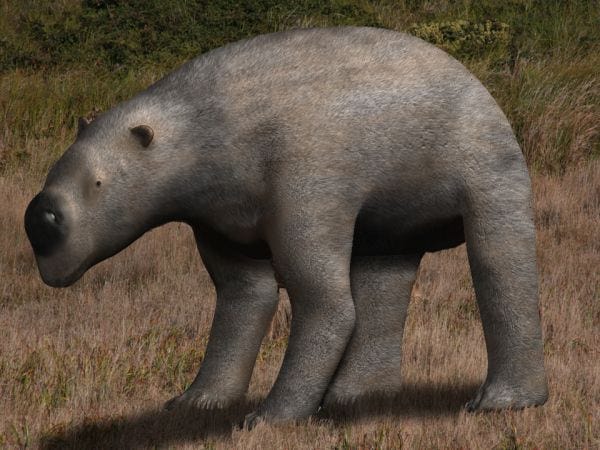
Speaking of marsupials that are no longer with us, the prehistoric Australian roster included a lion-sized carnivore (Thylacoleo carnifex) and a rhino-sized mega-herbivore (Diprotodon) that roamed the plains in large herds.
Also giant kangaroos! These guys weighed over five hundred pounds. Some people think that the largest kangaroos wouldn’t have been able to hop and would have instead strolled upright on two legs like a human.
Coda: monotremes are just really weird
There was a lot of academic discourse in the seventies and eighties about the relative advantages of the marsupial and eutherian modes of reproduction. Academics wrote many, many papers accusing other people of thinking marsupials were “inferior” mammals or defending themselves from such accusations. Strangely, no one stood up for the monotremes.
I’m not going to stand up for them now. I think it’s pretty likely that monotremes are in some sense worse—less adaptable or less fertile—and it’s not just bad luck that their diversity has diminished and their continents have been steadily taken over by the marsupials and then the eutherians.
But I love strange mammals, and so I’m grateful that the monotremes have hung on long enough for us to study them. In celebration, I’ll finish this post with some of my favorite monotreme facts.
Monotremes can sense nearby electric currents. For platypuses, this is the main form of sensory guidance they use while hunting underwater, since they shut their ears, eyes, and nose before they dive.
Platypuses are one of the few biofluorescent mammals. They look like this under UV light.
Monotremes also have a different sex chromosome system than other mammals. Marsupials and eutherians have two sex chromosomes (XX or XY), but female monotremes have ten Xs and males have five Xs and four or five Ys (depending on the species), which is crazy! I don’t think I’ve ever heard of a species with that many sex chromosomes.
And as far as I can tell, they evolved this chromosome system totally independently from other mammals. Eutherian and marsupial sex chromosomes match each other—they have similar genes in similar orders—which suggests that they both developed from the same chromosome in the common ancestor of eutherians and marsupials. But none of the monotreme sex chromosomes match the eutherian/marsupial chromosomes in this way. If anything, they kinda look like bird sex chromosomes. Weird!
Platypuses are also one of the few venomous mammals. Male platypuses have venomous spurs on their hind limbs, which they use during mating season to fight off rival males.
Echidnas have a much more civilized mating ritual, in which males will form an orderly single-file line behind a female and follow her around for hours or days. The suitors organize themselves by size, with the biggest at the front of the line—the female will have sex with whoever’s at the head of the queue when she’s ready to mate. Naturalists have seen lines of up to eleven males behind a single female.
But platypuses make up for their lack of an adorable courtship ritual by having very adorable sex. The couple mates in water for up to 20 minutes at a time. There isn’t any pelvic thrusting or anything. The pairs’ genitals lock together and then the female swims forward slowly, towing the male behind her, while the male strokes her back and head.
Their small size makes this strategy viable. Smaller animals have a greater surface area to volume ratio: surface area controls the rate at which they can intake oxygen and dispose of carbon dioxide through their skin, while volume is proportional to the total amount of cells and thus the overall demand for oxygen. See J. B. S. Haldane’s classic essay On Being the Right Size for more on this and other tradeoffs that animals face at different sizes.
It’s not totally clear what the evolutionary advantage of the spikes is.
One clue is that penis spikes often happen in species where females only ovulate after they’ve had sex. So maybe the spikes are there to make sure that the female really knows that sex is definitely happening (source: owwwwww) and it’s time to release some eggs? Or maybe the spikes are there to scrape out the sperm left by the female’s previous mates? Or maybe the spikes hook into the vagina wall and make it harder for the female to pull away, which lets the male ejaculate for longer?
If you’re thinking that it sounds pretty unpleasant to be on the receiving end of a spiky penis, yep, it often is. But fairly adversarial reproductive strategies can and do evolve, and spiky penises are far from the worst.
Eutherian pregnancy length is strongly correlated with adult size. Interestingly, marsupial pregnancy length is pretty weakly correlated with adult size.
That example and a lot of arguments in this section comes from this excellent paper.
If you can’t tell, I’m watching a time-lapse video of a kangaroo infant as I write this.
Africa and South America were closer back then, and the oceans were lower, but the journey still would have involved traveling ~1000 miles over the open sea.
Okay, fine, that’s not the real alternative hypothesis. The other explanations are some combination of:
Humans hunting the thylacines and Tasmanian devils and/or indirectly causing ecosystem changes that disadvantaged the marsupial carnivores. Humans had been in Australia for tens of thousands of years before the introduction of the dingo, but their population probably increased a lot about 3000 years ago.
Climate change, which caused more frequent droughts.
From Thompson (1987), which is investigating how quickly a population could grow under basically ideal conditions---i.e., if each female reproduced continually starting at the typical time of female reproductive maturity and finishing at the typical time that females stop reproducing, each time producing a litter of average size. Because he’s trying to estimate the maximum possible growth rate, he mostly sticks to data from animals in captivity with unlimited food, which is of course not the typical situation.
I wonder how many of the babies that get fired blindly out of the cloaca actually land in the pouch. Wait, is this why Tasmanian devils have such an excessive number of babies?
Tasmanian devil adults regularly eat juvenile Tasmanian devils. The first attempt to breed devils in captivity ended when the dad ate his offspring. (In the wild, Tasmanian devil fathers are long gone by the time their kids are born, so they’re not really adapted to avoid eating babies they encounter. The zookeepers hadn’t figured this out and kept the dad in the same enclosure as his mate and her children).
To be clear, devils don’t kill cows. They just opportunistically eat cows that died of natural causes.
This list and most of the Tasmanian devil facts in this section are from David Owen and David Pemberton’s book Tasmanian Devil: A Unique and Threatened Animal.


Wait, "sand-swimming" is real? I remember hearing about how, like, sandworms can't exist because the abrasion would destroy you. But marsupial moles do it?
Thank you for writing this, I really enjoyed it and wish I was still teaching Biology so I could tell my students some of these fascinating facts