American effective altruists should probably donate to political candidates

My recommendation for donors who are American citizens or permanent residents is that they donate directly to high-value political candidates.
If you care about AI safety, you should donate to:
Alex Bores—New York’s 12th District.
Scott Weiner—California’s 11th District.
If you don’t care about AI safety, you should donate to:
Jasmeet Bains—California’s 22nd District.
Ben McAdams—Utah’s 1st District.
Bobby Pulido—Texas’s 15th District.
Rebecca Cooke—Wisconsin’s 3rd District.
Geoff Duncan—Georgia governor.
Anita Earls—North Carolina Supreme Court.
Early readers of this post also recommended:
Dan Osborn—Nebraska Senate.
Janelle Bynum—Oregon’s 5th District.
Marie Gluesenkamp-Perez—Washington’s 3rd District
If you’re going to donate to a political campaign, it’s probably best to donate before the end of 2025.1 A lot of the effect of political donations is showing that a particular candidate is the frontrunner, which means that people are more likely to donate to them and endorse them, which makes them more likely to win. If you donate before January 1, your donations will be included in Q4’s fundraising report, which further advantages your candidate.
You are going to see this post again—next time with nonpolitical donation recommendations for non-Americans, the apolitical, and aspiring Republican staffers—on January 2nd. I wanted to tell people about the time-sensitive information, but no one reads Substacks in late December because they’re too busy spending time with their families, so I also wanted to run the post when anyone would read it. I apologize for how annoying this is to faithful Thing of Things readers and readers who hate their families.
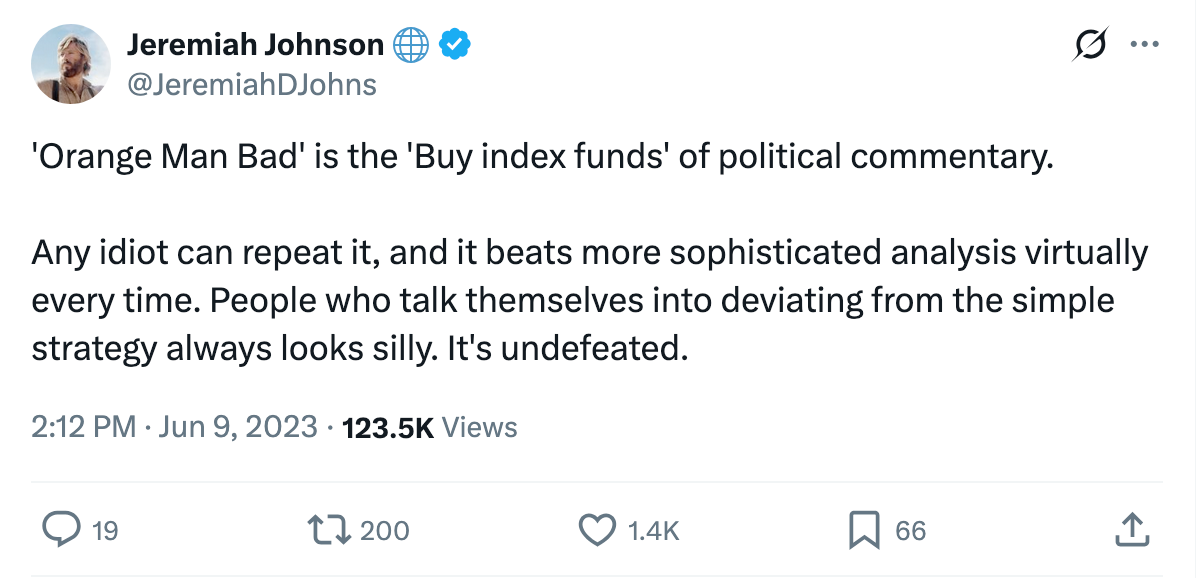
Why Is Donald Trump Bad?
U. S. Democracy
Let’s be clear about this: the current president of the United States tried to do a coup to overthrow the results of a free and fair election which he lost.
It’s true it was an ineffectual coup that had very little chance of succeeding. Once upon a time, however, attempting any coup would have ruled out someone from the presidency, and “well, he wasn’t very good at it” wasn’t considered a defense.
Donald Trump’s first presidency was remarkably similar to a normal Republican presidency. The norms and institutions of American democracy managed to check his most autocratic impulses. His aides managed to work around him to get governing done. You wouldn’t have been unreasonable, in December 2024, to predict that Trump’s presidency would mostly just be embarrassing.
Unfortunately, Trump has learned from his mistakes. At present, Trump is actively pursuing the consolidation of power in the executive branch. It’s easy to get caught up in the endless waves of bad news from the Trump administration, many of which doesn’t distinguish the important (ICE mobilizations) from the goofy (Trump calls the Norwegian finance minister to lobby for a Nobel Peace Prize) to the frankly gossipy (Olivia Nuzzi said what in her memoir?). But let me try to lay out the situation as clearly as I can.
Trump is taking control of traditionally independent positions in the civil service—from prosecutors to the head of the Bureau of Labor Statistics—and trying to fill them with political loyalists who will do his bidding. He has used retaliatory arrests and prosecutions against people who investigated him. He is subverting the checks and balances placed upon his power by the Constitution. He has openly defied as many as one in three court orders against him. He has broken the law to avoid spending money allocated by Congress. He has taken power from the states—most famously by deploying California’s National Guard without the consent of the governor of California. He has also targeted the institutions of civil society that are supposed to check the power of the president: the press, law firms, universities.
Most frighteningly, Trump has continued to say he won the 2020 election. He pardoned the January 6 rioters who, again, tried to perform a coup against the U.S. government to make him president. He has targeted the people who prosecuted the January 6 rioters. He has hinted publicly at wanting to run for an unconstitutional third term.
Metaculus forecasts a relatively high level of threat to U.S. democracy; however, I find the Threat Index a bit hard to interpret. It also forecasts a 10% chance that the U.S. is no longer a democracy by 2030 but that one has fewer predictions.
Now, the situation is not quite as dire as it is in other countries backsliding from democracy. Trump has to prioritize removing independent civil servants because the U.S. government has a strong norm of an independent civil service; many other autocrats came to office with a civil service that was already seen as a tool of the presidency’s will and a source of patronage for its clients. Trump has defied the courts, but he hasn’t been able to pass laws to bring it under his control. And Trump has mostly stuck to removing federal funding from civil-society institutions; he has yet to do mass arrests of his political enemies or make significant use of state-supported political violence.
But the Trump administration’s subversion of democratic norms is shockingly rapid: remember, Trump got into office this year. And instead of slowly going institution by institution, the Trump administration has attacked democratic norms on all levels simultaneously.
I also think U.S. democracy is far more important than democracy in Brazil or Turkey–at least for people who don’t live in any of those countries. On a practical level, America is currently the global hegemon. America being authoritarian, hostile to other countries, and irrational affects every country in the world. As one example, freedom of navigation–the principle that ships should be free to move in international waters–is enforced by the U.S. Navy. If the US does not back freedom of the seas, global shipping becomes wildly more expensive at best and impossible at worst. In that case, many places that aren’t America would face economic collapse and starvation. That is merely one example of what can go wrong if America becomes a dictatorship run by a corrupt, irresponsible, incompetent man who is actively opposed to America’s role in the international order.
On a symbolic level, America is the best-known country in the world and a beacon of capitalist, liberal democracy, the best system of government ever invented. If we fall to illiberal autocracy, it emboldens dictators and human-rights violators all around the world. The sense that human rights, liberalism, and democracy are good things is a very real constraint on what abusive governments can do.2 America’s human rights track record– at home and abroad– is hardly spotless. But it sure as hell beats China or Russia. And I don’t think we’re going to like what happens when we replace an international order where governments give lip service to human rights with one of unrestrained will to power.
USAID
USAID was very far from a perfect organization. Indeed, much of the money spent by USAID was spent in ways that underperformed just giving people the cash, and much of the organization was resistant to adopting more evidence-based policies.
But, ultimately, U.S. foreign aid saved 3.3 million lives per year. The vast majority of that money has been cut, with USAID being destroyed entirely. Other countries and non-governmental organizations will only be able to pick up a tiny amount of the slack. Millions of people are going to die.
Can we expect a Democrat to increase funding to foreign aid? Probably, yes. USAID spent sixty years as an uncontroversial bipartisan program. USAID was cut, not out of principled Republican opposition to foreign aid, but because of the idiosyncratic personal views of Elon Musk. Foreign aid, although unpopular, is a low-salience issue where the views of politicians and policymakers dominate. Politicians and policymakers like saving lives, particularly when it costs them nothing to do so.
Artificial Intelligence?
The common-sense case for AI regulation is very simple. If the CEOs of the companies developing a technology go around, in public, saying that they think that a technology might drive humanity extinct, our regulatory approach shouldn’t be #yolo.
You don’t have to go full Eliezer Yudkowsky to support AI regulation. The vast majority of technologies-- new cancer treatments, better solar panels, balance bikes-- have a 0% chance of causing human extinction. If something has a 0.1% chance of causing human extinction, that entirely justifies staffing a division of regulators to ask pointed questions of the manufacturers.
I was convinced by this article that the date at which we will achieve artificial general intelligence is bimodal: either it will happen by 2030-2032, or it will be several decades away.3 The author of this article puts about 50/50 odds on each possibility. I’m not sure I’d go that far, but even a 5% chance of the development of AGI by 2030 is frightening.
If we get AGI soon, the Trump administration will develop the regulations that govern this technology. I find this worrying for several reasons. First, across policy areas, the Trump administration has shown little interest in consulting with experts or implementing evidence-based policies; it has eviscerated technocratic institutions and replaced them with political spoils for Trump loyalists. Do you want the man who appointed Robert F. Kennedy Jr. as Health Secretary to make decisions about a very important, very complex emerging technology? I don’t.
Second, Trump is specifically getting advice from Marc Andreessen. You can read Marc Andreessen’s views on AI here. It is rather short on arguments that we shouldn’t be worried about AI risk, and long on accusations of AI safety advocates being a conspiracy theorist cult who read too much Mary Shelley. Nothing to worry about here! Surely if there’s one thing we’ve learned in the past twenty years it’s to trust in the disinterested, self-sacrificial altruism of tech billionaires.
Much like a fossil-fuel executive advising about climate policy, or a tobacco company executive advising about the harms of smoking, Marc Andreessen has no interest in admitting any harms or risks of his technology that might reduce his profit margins. This is a completely reckless approach to regulation of any powerful new technology.
Why Donations?
How Do Donations Help?
No one knows how much it costs to flip a vote, sorry. Political moneyball is insanely complicated. Money can be spent well or wasted. No amount of money can convince voters to vote for an unelectable candidate; on the other hand, good candidate selection can make money go much farther. In some cases, it’s even possible for additional money to make a candidate less likely to get elected.4
But it does seem obviously true that at least some ways of spending money make candidates more likely to win elections. Voter registration and get-out-the-vote efforts probably remind some people that elections are happening and convince them that they want to vote rather than scroll TikTok. If people have heard of a candidate and have some idea what she stands for, they might vote for her. Ozy’s Mom (my normie liberal focus group) often votes for local or statewide offices where she hasn’t heard of any of the candidates, so she picks either the woman or the person with an Asian-sounding or Latino-sounding surname. Advertisements can improve on this ignoble status quo.
Politicians spend a lot of time fundraising: some estimates suggest Congresspeople spend as much as 50% of their time fundraising. You have heard that calling your Congressperson is a good way to make your opinions known. But your voice goes farther if you donate.
Why To Candidates?
You should make donations directly to candidates (”hard money” donations).
Money given directly to a candidate goes farther because:
Candidates get better rates on advertisements than non-candidates.
Outside groups aren’t allowed to coordinate with candidates. Hard-money donations allow candidates to have a unified strategy based on what does best in their internal polling. Money is less likely to be wasted through duplicating effort some other group has already made.
Candidates, even in safe seats, are expected to fundraise “dues” for their party to help their party win more contested elections. Candidates who want powerful positions like committee chairs are expected to raise even more. So donating to your candidate gives them more influence.
This doesn’t really matter for non-AI-safety-focused donors but it matters for AI-safety-focused donors.
A friend of mine says that campaign finance legislation is set up to give the top 10% more influence at the expense of the top 1%. How does this work?
The most you can donate to a federal political candidate is $7000 ($3,500 for the primary and $3,500 for the general). In many states, state-level candidates also have limits.
In conventional nonprofits, most funding comes from a small number of very rich people. For example, more than half of effective altruist funding comes from Coefficient Giving, which is mostly funded by a single person, Dustin Moskovitz.
If you maxed out donations to all the candidates I presently recommend, you would donate $64,000.5 That’s a pretty big chunk of change, but it’s approximately the donation budget of an American with 99th percentile income who has taken the Giving What We Can pledge. That is also exactly the same amount as Dustin Moskovitz can donate to my recommended candidates.
In short, hard-money donations to political candidates are a very important area where the low-hanging fruit cannot possibly be picked by billionaires.
Why Now?
If you plan to donate in the next year, you should donate as soon as possible.
First, you can donate twice as much if you donate during the primary. Candidates are not required to spend your primary-election donations during the primary. (If your candidate loses the primary, however, your second $3,500 will be refunded.)
Second, candidate selection is important. If we want to flip red districts, we need to choose moderate candidates-- candidates who are borderline Democrats In Name Only. But primary elections often wind up choosing candidates who are far more extreme than could reasonably win their district: witness the number of Californian districts where the Republican candidate is a gun-loving pro-life antivaxxer who thinks fluoride is a Communist plot to pollute our bodily fluids. The worst outcome is for a potentially flippable district to have a Democratic candidate who says “pregnant people” and praises the Green New Deal.
(Does this mean, if you’re progressive, potentially donating to candidates whose views you dislike? Yep. We do not have the luxury of caring about anything except American democracy, USAID, and maybe AI safety.)
Third, it’s very difficult for candidates to effectively spend money they didn’t budget for and that came in during the last six weeks of an election. Late donations often wind up wasted. Early donations allow candidates to make plans using money they’re certain they’re going to have.
That said, some donors may wish to save their money and do large donations during the 2028 cycle. I don't think we're going to get another set of AI safety candidates as good as Scott Wiener and Alex Bores. However, non-AI-focused donors may reasonably conclude that early donations to key candidates in 2027 and 2028 are more valuable than the relatively late donations they can do in the 2026 cycle. Up to you.
Who Shouldn’t Donate?
In the United States, your political donations are publicly available information. This doesn’t matter for most people; it might matter for you.
The most important caveat:
If you are willing and able to take a position in the Trump administration, you shouldn’t make a donation and you should probably take the position.
Obviously, you shouldn’t take a position that makes the Trump administration more effective at overthrowing American democracy. But the first Trump administration was an ordinary Republican administration because a huge number of policymakers, advisors, and civil servants thwarted Trump’s authoritarian instincts. To the extent you can put yourself in a position to do the same, you should.
Many heroic people serve in the Trump administration: keeping vaccines somewhat more accessible, making AI regulation somewhat saner, preserving whatever scraps of foreign aid they can, being one more voice in the the Department of War or the State Department or the Department of Justice who will stand in the face of authoritarianism and say “no.” Consider how principled and conflict-friendly you are, get support from people who will hold you to your moral standards, save your money so you can quit your job if necessary, and take the job.
You may not be well-suited to taking a job in the Trump administration. However, if you want certain political positions, a history of donations to Democrats may hurt you. Here is a helpful quiz to help you figure out if you should avoid donating.
Where To Donate?
If You Care About AI Safety
You should donate to Alex Bores and Scott Wiener. They are both state representatives with a track record of effective state-level advocacy in favor of AI regulation.
Eric Neyman has written excellent pieces explaining why AI-safety-focused donors should donate to Alex Bores and Scott Wiener which I encourage you to read if you’re an AI-focused donor.
If You Don’t Care About AI Safety
My recommendations follow Slow Boring’s. Although Matt Yglesias is a somewhat controversial figure—particularly among my more progressive readership—we want to flip red seats. That means voting for moderates.
Strong candidates in the House include:
Jasmeet Bains—California’s 22nd District.
Ben McAdams—Utah’s 1st DIstrict.
Bobby Pulido—Texas’s 15th District.
Rebecca Cooke—Wisconsin’s 3rd District.
Candidates that help the Democrats win future redistricting fights include:
Geoff Duncan—Georgia governor.
Anita Earls—North Carolina Supreme Court.
Early readers of this post also recommended:
Dan Osborn—Nebraska Senate.
Janelle Bynum—Oregon’s 5th District.
Marie Gluesenkamp-Perez—Washington’s 3rd District
Matt Yglesias’s other recommendations focus on shifting the Democratic Party towards moderation, so I don’t want to endorse them, as Thing of Things has a more politically diverse readership than Slow Boring.
If you don’t want to subscribe to Slow Boring, I will rerun this post when Matt Yglesias comes out with new recommendations. Sorry, guys. You are going to get SO sick of this post.
Lobbying Congresspeople You Donate To
Some candidates’ donation portals will allow you to include a message. You can always call a candidate’s offices and say that you maxed out your donations because you care about $issue, which I understand candidates do take into account. You will probably not get to talk to a candidate unless you’re e.g. a bundler who convinces a number of individuals to donate.
Thanks to Keller Scholl, Eric Neyman, and an anonymous person. All mistakes are my own.
I realize that this is extremely little notice. In my defense, please consider who I am as a person.
I’m going to write more about this in a future post.
Of course, AI timelines are very controversial among AI experts.
Effective altruists may remember the case of Carrick Flynn, where excessive soft money from FTX’s SuperPAC may have made voters see him as an out-of-touch “crypto candidate” being forced on them by Sam Bankman-Fried.
Or $85,000 if you include the suggestions from my early readers.
I overall like this post and I find the arguments that electing Democrats is really important and donating to strong candidates helps achieve that goal convincing, but it doesn’t really make a case for those donations being more cost-effective than donating to AI safety orgs or GiveWell. Do you know of any analysis which tries to directly compare the expected effects of spending a dollar on the most important elections to spending it on e.g. malaria nets? Or do you have any arguments for why we should expect political donations to have competitive cost-effectiveness without that?
Any political analysis that says "politician X is universally bad" is pretty much guaranteed to be poorly thought out and driven by some kind of hysteria rather than rational thinking.
Trump 2 is so far looking very good for American democracy. Lets go through some of your claims:
> Trump is taking control of traditionally independent positions in the civil service—from prosecutors to the head of the Bureau of Labor Statistics—and trying to fill them with political loyalists who will do his bidding.
Think for a moment about what you are saying here. I remember a time when Republicans thought President Biden was going senile and that the deep state was secretly running everything behind the scenes. The mainstream narrative at the time tried to frame these Republicans as crazy. Then it became undeniable that President Biden was going senile, and we never got a straight answer about who had been running things behind the scenes. Now you are telling us that of course the deep state is running everything behind the scenes, and that it is somehow a threat to democracy for the democratically elected leader of our government to try to run things instead?!?!
This I think is our biggest crux. The idea that any bureaucrat can exercise part of the awesome power of the government without political accountability is horrifying to me. The narrative I was given at every level of our education system, from elementary school through law school, was that it was ok for prosecutors and bureaucrats to exercise that power, because they all answer to the president, who in turn answers to the voters. That was what I read in the United States Constitution when it said that all of the executive power is vested in the president. That was the thing that was supposed to safeguard us from bureaucrats and prosecutors becoming dictators. Now we are being told that that isn't true, that that was never true, that these prosecutors and bureaucrats have been acting as dictators all along. I want my democracy back! And Trump is fighting to get me my democracy back. In the long run this may do more to strengthen democracy than his attempted coup did to damage it.
> He has used retaliatory arrests and prosecutions against people who investigated him.
There has definitely been damage to democracy here, I grant, but it was the Democrats who started it, not Trump. You remember the prosecution of Trump over the Stormy Daniels thing? A prosecution that in normal times nobody would have bothered with even if it had been legal, and that was definitely not legal because it violated the statute of limitations. The Democrats crossed a huge red line there and took our democracy in a very dark direction. I wish we had a president who could pull us back from that, and Trump sadly but unsurprisingly is not that man, but I also can't really blame him for playing by the same rules that were used against him.
> He has openly defied as many as one in three court orders against him.
I don't believe this for a second. The first couple times I saw these claims I looked into them and they did not hold up. I'm no longer taking the time to look in to each individual case, and I certainly am not going to give the Washington Post my money, but if you have a particular case in mind that you think is a particularly strong example of this I am willing to look into it.
> He has broken the law to avoid spending money allocated by Congress.
Yea, that's not great. You know what else is not great? His predecessor breaking the law to avoid collecting debts that former college students owed to the American people. Again, this just looks like Trump playing by the same rules the Democrats played by the last time they were in power.
> He has taken power from the states—most famously by deploying California’s National Guard without the consent of the governor of California.
The constitution allocates power over the military, including the national guard, to the President, not to the governors. And it is sometimes right and proper for a president to use that power to keep the peace and enforce the law. I recall another Republican president famously deploying the 101st Airborn Division to Little Rock, AK, a decision now rightly celebrated in the history books. It may have been unwise or even illegal for Trump to deploy the guard under the current circumstances, but it was definitely not an invasion of state power.
> He has also targeted the institutions of civil society that are supposed to check the power of the president: the press, law firms, universities.
He has been more political than some other presidents in choosing which elements of the press to give access to, but access has always been the president's to give. Biden took advantage of this to hide from the press when he was going senile, and nobody said he was targeting the press.
It is the sacred right of every litigant to choose their own lawyers, and fire their own lawyers, for whatever petty and childish reasons they choose. As head of the executive branch, it is Trump's sacred right to choose the executive branches lawyers, and fire the executive branches lawyers, for whatever petty and childish reasons he chooses. That's all he's done.
The universities were NEVER supposed to be a check on the power of the president. That is a horrifying misuse of those institutions, and the reason the president is rightly coming down on them. Universities are supposed to pursue truth outside the realm of politics, and they are supposed to do so in a way that is welcoming to people of all political persuasions, all races, all sexes, and all religions, and that does not take sides on political issues or politicians. That was the promise that universities made to the American people in exchange for the incredible degree of financial support and independence they have received since ww2. The Universities broke that contract. And that sucks. I really wish they hadn't, because they were important institutions, and they have left a vacancy that will be difficult to fill. But what is happening now is the natural and foreseeable consequence of that choice.
> Most frighteningly, Trump has continued to say he won the 2020 election. He pardoned the January 6 rioters who, again, tried to perform a coup against the U.S. government to make him president. He has targeted the people who prosecuted the January 6 rioters. He has hinted publicly at wanting to run for an unconstitutional third term.
Yea, you are definitely right that in past generations attempting a coup would have been disqualifying. I wish it still was. This is definitely the thing that gives me most pause about Trump, and the dominant reason I voted against him in 2024. But the American people have spoken, and they clearly do not regard it as disqualifying. As for a third term, I'd be shocked if it gets any real traction. And if, somehow, it does happen, I'll join the resistance then.
If there is an EA case against Trump, I think it would have to be that all this democracy stuff is too speculative and uncertain to satisfy the rigorous epistemological standards we demand of ourselves as EAs, and the damage Trump has done on foreign aid and foreign policy more generally is worth fighting against. There is a whole argument that by pulling the US back from its traditional role as world cop, Trump has significantly increased the risk of ww3 breaking out, and the catastrophic and existential risks that go along with that. You should be making that argument!