Donation recommendations for effective altruists (July 2026)

My recommendation for donors who are American citizens or permanent residents is that they donate directly to high-value political candidates.1
My recommendation for other donors is the GiveWell All Grants Fund, except other donors with idiosyncratic preferences who should donate to other things.
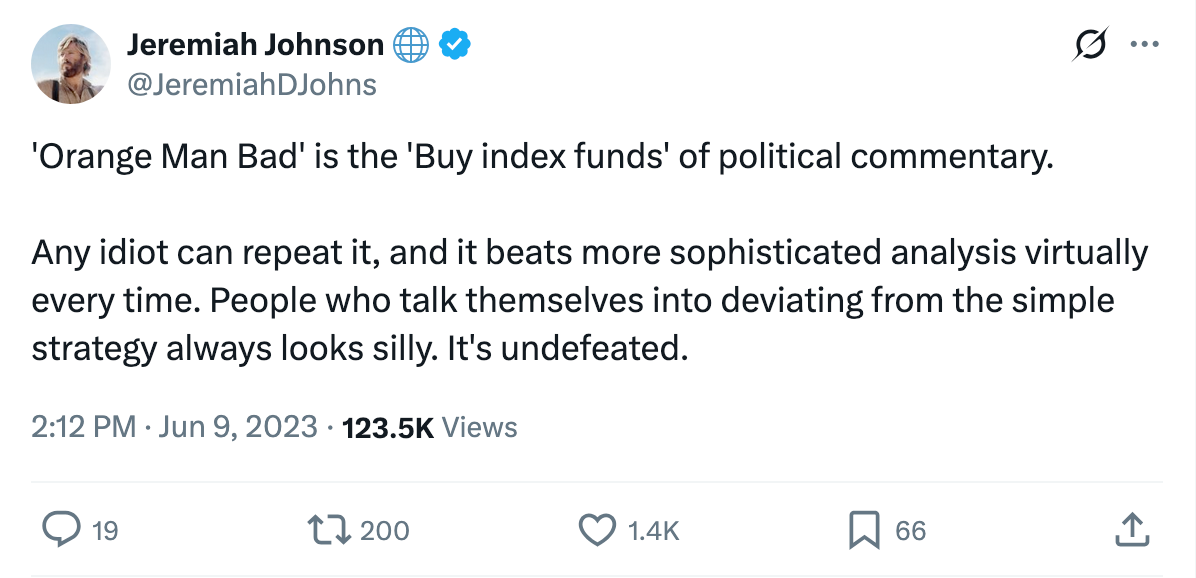
Why Is Donald Trump Bad?
U. S. Democracy
Let’s be clear about this: the current president of the United States tried to do a coup to overthrow the results of a free and fair election which he lost.
It’s true it was an ineffectual coup that had little chance of succeeding. Once upon a time, however, attempting any coup would have ruled out someone from the presidency, and “well, he wasn’t very good at it” wasn’t considered a defense.
Donald Trump’s first presidency was remarkably similar to a normal Republican presidency. The norms and institutions of American democracy managed to check his most autocratic impulses. His aides managed to work around him to get governing done. You wouldn’t have been unreasonable, in December 2024, to predict that Trump’s second term would mostly just be embarrassing.
Unfortunately, Trump has learned from his mistakes. At present, Trump is actively pursuing the consolidation of power in the executive branch. It’s easy to get caught up in the endless waves of bad news from the Trump administration, many of which doesn’t distinguish the important (ICE mobilizations) from the goofy (the Reflecting Pool continues greenish) to the frankly gossipy (Olivia Nuzzi said what in her memoir?). But let me try to lay out the situation as clearly as I can.
Trump has used retaliatory arrests and prosecutions against his political opponents—something he’d explicitly promised to do before being elected. He is openly rewarding people and corporations for donations with high-level government positions, pardons, and political favors. Trump has profited from the presidency to the tune of $3 billion, including bribes from authoritarian dictatorships like Qatar, Saudi Arabia, and the United Arab Emirates.2
Trump is taking control of traditionally independent positions in the civil service—from prosecutors to the head of the Bureau of Labor Statistics to the National Science Board—and trying to fill them with political loyalists who will do his bidding. The Supreme Court’s recent Trump v. Slaughter decision found that the president has the power to remove independent agency heads (other than the Fed) at will, further increasing Trump’s power.
Trump is is subverting the checks and balances placed upon his power by the Constitution. He has openly defied as many as one in three court orders against him. He has broken the law to avoid spending money allocated by Congress. He has taken power from the states—most famously by deploying California’s National Guard without the consent of the governor of California. He has also targeted the institutions of civil society that are supposed to check the power of the president: the press, law firms, universities. The administration has publicly stated that any leftists who protest that the government is violating their rights are lying. His disrespect for the Constitution extends to trying to end birthright citizenship, one of the most fundamental rights protected by the Fourteenth Amendment.
Most frighteningly, Trump has continued to say he won the 2020 election. He pardoned the January 6 rioters who, again, tried to perform a coup against the U.S. government to make him president. He tried (and fortunately failed) to create a $1.8 billion fund to pay off victims of “weaponization and lawfare”, i.e. people prosecuted for election tampering or attempted insurrection. He has targeted the people who prosecuted the January 6 rioters. He is meddling with the 2030 Census, which will govern apportionment and the Electoral College for the next decade. He has hinted publicly at wanting to run for an unconstitutional third term. Trump continues to use false claims about election integrity to claim unconstitutional federal authority over elections.
I find the behavior of Secretary of War Pete Hegseth particularly worrying. A friend of mine who works in U.S. defense policy says:
So, if I was Hegseth, and trying to plot a coup, my main plan would be “fire people until the military coughs up someone more loyal to Trump than the Constitution”, which would take a while, but I might block promotions of the politically suspect (women and African-Americans), fire existing popular leadership so there wasn’t an obvious person to coalesce around as resistance, and try to increase morale and popularity with a bunch of dumb ideas. Getting us into a war would probably help on the margin.
To be clear, Hegseth might not be trying to stage a coup! He might just be doing a horrifically bad job as Secretary of War. But if he was trying to prepare to stage a coup, it’s not obvious what he would be doing differently.
Metaculus forecasts a relatively high level of threat to U.S. democracy; however, I find the Threat Index a bit hard to interpret. It also forecasts a 15% chance that the U.S. is no longer a democracy by 2030 but that one has fewer predictions.
Now, the situation is not quite as dire as it is in other countries backsliding from democracy. Trump has to prioritize removing independent civil servants because the U.S. government has a strong norm of an independent civil service and apolitical military; many other autocrats came to office with a civil service that was already seen as a tool of the presidency’s will and a source of patronage for its clients. Trump has defied the courts, but he hasn’t been able to fully bring them under his control. And Trump has mostly stuck to removing federal funding from civil-society institutions; he has yet to do mass arrests of his political enemies or make significant use of state-supported political violence.
But the Trump administration’s subversion of democratic norms is shockingly rapid. And instead of slowly going institution by institution, the Trump administration has attacked democratic norms on all levels simultaneously.
I also think U.S. democracy is far more important than democracy in Brazil or Turkey—at least for people who don’t live in any of those countries. On a practical level, America is currently the global hegemon. America being authoritarian, hostile to other countries, and irrational affects every country in the world. As one example, freedom of navigation—the principle that ships should be free to move in international waters—is enforced by the U.S. Navy. If the US does not back freedom of the seas, global shipping becomes wildly more expensive at best and impossible at worst. In that case, many places that aren’t America would face economic collapse and starvation. That is merely one example of what can go wrong if America becomes a dictatorship run by a corrupt, irresponsible, incompetent man who is actively opposed to America’s role in the international order.
On a symbolic level, America is the best-known country in the world and a beacon of capitalist, liberal democracy, the best system of government ever invented. If we fall to illiberal autocracy, it emboldens dictators and human-rights violators all around the world. The sense that human rights, liberalism, and democracy are good things is a very real constraint on what abusive governments can do. America’s human rights track record—at home and abroad—is hardly spotless. But it sure as hell beats China or Russia. And I don’t think we’re going to like what happens when we replace an international order where governments give lip service to human rights with one of unrestrained will to power.
USAID
Under the Trump administration, USAID has been de facto destroyed. Fortunately, we’re not in the absolute worst-case scenario many people worried about in early 2025. Much of the funding has been restored, although not to previous levels. Foreign aid is now under the aegis of the State Department, which has a lot of other stuff going on and doesn’t have the institutional knowledge that USAID had. (This is a good article about the current state of U.S. foreign aid and this is a good article about the current state of PEPFAR.)
USAID was very far from a perfect organization. Indeed, much of the money spent by USAID was spent in ways that underperformed just giving people the cash, and much of the organization was resistant to adopting more evidence-based policies. But, ultimately, U.S. foreign aid saved 3.3 million lives per year. Because the Trump administration callously smashed the foreign-aid infrastructure without any thought for how to replace it, millions of people are going to die. But, sure, we saved the Africans from woke DEI operas.

Can we expect a Democrat to increase funding to foreign aid and organize it in some more sensible way? Probably, yes. USAID spent sixty years as an uncontroversial bipartisan program. USAID was cut, not out of principled Republican opposition to foreign aid, but because of the idiosyncratic personal views of Elon Musk. Foreign aid, although unpopular, is a low-salience issue where the views of politicians and policymakers dominate. Politicians and policymakers like saving lives, particularly when it costs them nothing to do so.
The Iran War
I cannot believe I have to put a new section in this post.
The war with Iran has been an unmitigated humanitarian and foreign-policy disaster. It has weakened the United States’s international reputation and emboldened Iran, which now believes that it can stand up to a full-on military assault by the United States. It has accomplished nothing to bring freedom to the Iranian people. The blockage of the Strait of Hormuz has raised oil and fertilizer prices worldwide. That means that millions of people will go without food and the supply chains for crucial medicines and vaccines will be disrupted. And, as always during wars, many innocent people are going to die.
I still remember when people said that we should vote for Trump because he wouldn’t entrap us in foreign-policy adventurism.
Artificial Intelligence?
The common-sense case for AI regulation is very simple. If the CEOs of the companies developing a technology go around, in public, saying that they think that a technology might drive humanity extinct, our regulatory approach shouldn’t be #yolo.
You don’t have to go full Eliezer Yudkowsky to support AI regulation. The vast majority of technologies-- new cancer treatments, better solar panels, balance bikes-- have a 0% chance of causing human extinction. If something has a 0.1% chance of causing human extinction, that entirely justifies staffing a division of regulators to ask pointed questions of the manufacturers.
I was convinced by this article that the date at which we will achieve artificial general intelligence is bimodal: either it will happen by 2030-2032, or it will be several decades away.3 The author of this article puts about 50/50 odds on each possibility. I’m not sure I’d go that far, but even a 5% chance of the development of AGI by 2030 is frightening.
If we get AGI soon, the Trump administration will develop the executive-branch regulations that govern this technology. It will also play a leadership role in getting laws passed about AGI. I find this worrying for several reasons. First, across policy areas, the Trump administration has shown little interest in consulting with experts or implementing evidence-based policies; it has eviscerated technocratic institutions and replaced them with political spoils for Trump loyalists. Do you want the man who appointed Robert F. Kennedy Jr. as Health Secretary or Pete Hegseth as Secretary of War to make decisions about a very important, very complex emerging technology? I don’t.
Second, Trump is specifically getting advice from Marc Andreessen. You can read Marc Andreessen’s views on AI here. It is rather short on arguments that we shouldn’t be worried about AI risk, and long on accusations of AI safety advocates being a conspiracy theorist cult who read too much Mary Shelley. Nothing to worry about here! Surely if there’s one thing we’ve learned in the past twenty years it’s to trust in the disinterested, self-sacrificial altruism of tech billionaires.
Much like a fossil-fuel executive advising about climate policy, or a tobacco company executive advising about the harms of smoking, Marc Andreessen has no interest in admitting any harms or risks of his technology that might reduce his profit margins. This is a completely reckless approach to regulation of any powerful new technology.
Why Donations?
How Do Donations Help?
No one really knows how much it costs to flip a vote, sorry. Political moneyball is insanely complicated. Money can be spent well or wasted. No amount of money can convince voters to vote for an unelectable candidate; on the other hand, good candidate selection can make money go much farther. In some cases, it’s even possible for additional money to make a candidate less likely to get elected.4
But it does seem obviously true that at least some ways of spending money make candidates more likely to win elections. Voter registration and get-out-the-vote efforts probably remind some people that elections are happening and convince them that they want to vote rather than scroll TikTok. If people have heard of a candidate and have some idea what she stands for, they might vote for her. Ozy’s Mom (my normie liberal focus group) often votes for local or statewide offices where she hasn’t heard of any of the candidates, so she picks either the woman or the person with an Asian-sounding or Latino-sounding surname. Advertisements can improve on this ignoble status quo.
Politicians spend a lot of time fundraising: some estimates suggest Congresspeople spend as much as 50% of their time fundraising. You have heard that calling your Congressperson is a good way to make your opinions known. But your voice goes farther if you donate.
Why To Candidates?
You should make donations directly to candidates (”hard money” donations).
Money given directly to a candidate goes farther because:
Candidates get better rates on advertisements than non-candidates.
Outside groups aren’t allowed to coordinate with candidates. Hard-money donations allow candidates to have a unified strategy based on what does best in their internal polling. Money is less likely to be wasted through duplicating effort some other group has already made.
Candidates, even in safe seats, are expected to fundraise “dues” for their party to help their party win more contested elections. Candidates who want powerful positions like committee chairs are expected to raise even more. These dues come from their hard-money funds. So donating to your candidate gives them more influence.
A friend of mine says that campaign finance legislation is set up to give the top 10% more influence at the expense of the top 1%. How does this work?
The most you can donate to a federal political candidate is $7000 ($3,500 for the primary and $3,500 for the general). In many states, state-level candidates also have limits.
In conventional nonprofits, most funding comes from a small number of very rich people. For example, more than half of effective altruist funding comes from Coefficient Giving, which is mostly funded by a single person, Dustin Moskovitz.
If you maxed out donations to all the candidates I presently recommend, you would donate $64,000. That’s a pretty big chunk of change, but it’s approximately the donation budget of an American with 99th percentile income who has taken the Giving What We Can pledge. That is also exactly the same amount as Dustin Moskovitz can donate to my recommended candidates.5
In short, hard-money donations to political candidates are a very important area where the low-hanging fruit cannot possibly be picked by billionaires.
Who Shouldn’t Donate?
In the United States, your direct political donations to candidates are publicly available information. This doesn’t matter for most people; it might matter for you.
The most important caveat:
If you are willing and able to take a political appointee position in the Trump administration, you shouldn’t make a donation to Democrats or anti-Trump Republicans (e.g. Rep. Thomas Massie) and you should probably take the position.
If you are willing and able to take a civil service position in the Trump administration, you should think carefully before making a donation and you should probably take the position.6
Obviously, you shouldn’t take a position that makes the Trump administration more effective at overthrowing American democracy. But the first Trump administration was an ordinary Republican administration because a huge number of policymakers, advisors, and civil servants thwarted Trump’s authoritarian instincts. To the extent you can put yourself in a position to do the same, you should.
Many heroic people serve in the Trump administration as political appointees: keeping vaccines somewhat more accessible, making AI regulation somewhat saner, preserving whatever scraps of foreign aid they can, being one more voice in the the Department of War or the State Department or the Department of Justice who will stand in the face of authoritarianism and say “no.” Consider how principled and conflict-friendly you are, get support from people who will hold you to your moral standards, save your money so you can quit if necessary, and take the job.
The vast majority of jobs in the US government are Civil Service roles. It is illegal for the government to discriminate in hiring for civil service roles based on your political affiliation, including your donations. However, the Trump administration has been known to break laws, and anecdotal evidence suggests that civil servants have faced career consequences for their political donations. Think carefully before donating.
You may not be well-suited to taking a job in the Trump administration. However, if you want certain political appointee positions, a history of donations to Democrats may hurt you. Here is a helpful quiz to help you figure out if you should avoid donating.
Most donation forms say that you can’t donate if you’re a federal contractor. This is primarily a restriction on sole proprietors and corporations. If you happen to work for a company that contracts with the federal government, you’re still allowed to donate.
Where To Donate?
Thing of Things recommends donating to Manny Rutinel, who is running in Colorado’s 8th District. Rutinel is a strong advocate for farmed animal welfare and for sensible regulation of AI (e.g. he supported whistleblower protections for AI lab employees).
People who prioritize AI safety should also donate to Scott Wiener, who is running in California’s 11th district. Scott Wiener’s campaigning led to SB-53, which requires companies to have some plan to prevent catastrophic AI-related outcomes. Because of California’s top-two primary system, Wiener is running against another Democrat. So non-AI-safety-focused donors shouldn’t donate to Wiener, because a Democrat will definitely represent San Francisco no matter what. On the other hand, Wiener’s campaign is a particularly good use of money for AI-safety-focused donors, because it’s much cheaper to convince Democrats to support a particular Democrat than to convince Republicans to support a Democrat.
If you are a Republican who is concerned about AI safety, consider reaching out to the AI Policy Network, who will be happy to recommend Republican donation targets.
If you have more money burning a hole in your donations budget, Thing of Things follows Slow Boring’s recommendations.
To flip the House and Senate:
Bobby Pulido (U.S. House, TX-15)
Josh Turek (U.S. Senate, Iowa)
Mary Peltola (Alaska)
Bill Hill (Alaska at-large)
Johnny Garcia (TX-35)
Don Davis (NC-01)
Lindsay James (IA-2)
Bale Dalton (FL-7)
Some state-level races are important for redistricting. This is a more morally complicated situation. I am opposed to gerrymandering, even if it benefits Democrats. But as long as Republicans have an advantage from their own gerrymandering, Democrats won’t achieve fairness by refusing to gerrymander themselves. Nevertheless, I think it makes sense to refuse to donate to advance gerrymandeirng.
For redistricting:
Anita Earls (North Carolina Supreme Court)
Keisha Lance Bottoms (Georgia governor)
Eileen Hartnett Albillar (Pennsylvania’s Sixth Senate District)
Sara Agerton (Pennsylvania House District 88)
John Kroll (Wisconsin’s Assembly District 85)
If you don’t want to subscribe to Slow Boring, I will rerun this post when Matt Yglesias comes out with new recommendations.
Lobbying Congresspeople You Donate To
Some candidates’ donation portals will allow you to include a message. You can always call a candidate’s offices and say that you maxed out your donations because you care about $issue, which I understand candidates do take into account. You will probably not get to talk to a candidate unless you’re e.g. a bundler who convinces a number of individuals to donate.
Donations for Non-Americans, the Apolitical, Future Republican Staffers, Et Cetera
Most donors should give to the GiveWell All Grants Fund. The USAID cuts mean that global poverty donations go farther than ever before. The GiveWell All Grants Fund allows GiveWell to use its own discretion to make grants, which means that it has more flexibility to respond to the confusing and ever-changing aid cuts situation. GiveWell chose their Top Charities in a very different aid environment, in which U.S. foreign aid had some priority areas—such as HIV and health-systems strengthening7—well-handled. Donating to the All Grants Fund allows GiveWell to make time-sensitive grants in these areas, even though GiveWell has yet to complete full Top Charities investigations.
Donors with particular idiosyncratic beliefs may want to give to other global poverty charities. Specifically:
Because malaria causes miscarriages, donating to the Against Malaria Foundation is by far the most effective charity for pro-life donors.
GiveWell is exploring programs such as giving farmed animals to developing-world farmers. Certain animal advocates may prefer to give to the GiveWell Top Charities Fund so that none of their money goes to purchasing farmed animals.
Donors who value animals at a significant fraction of the amount they value humans may continue to want to donate to animal advocacy. Some donors may also want to donate to animal advocacy for other reasons (for example, to offset meat consumption).
Donors who plan to donate over $10,000 a year and who care about farmed insects, farmed shrimps, or wild animals should contact Rethink Priorities to participate in their Neglected Animals Program, which collects publicly unavailable information to help medium-sized donors make the best decisions about helping neglected animals.
Donors who prefer a high level of certainty should donate to the Navigation Fund’s cage-free egg campaign fund. Cage-free egg campaigns affect chickens (who are almost certainly sentient) and are among the only animal advocacy interventions that have been conclusively shown to work.
Other donors should donate to the EA Animal Welfare Fund. You can find the most recent information about their plans here and their most recent payout report here.
Some donors may continue to prioritize global priorities research. In this case, I continue to endorse Rethink Priorities as the most exciting organization working in the space. Rethink Priorities’s research addresses some of the most important issues of our time, from farmed salmon welfare to ending lead poisoning to digital minds. Their approach is empirical: instead of ungrounded philosophical speculation, they dig deep into the evidence and find insights that people can actually use. They do consulting for real nonprofits, which keeps them connected to what nonprofits actually need. I am reliably impressed by Rethink Priorities’ reports and always learn something when I read them.
Thanks to Keller Scholl, Eric Neyman, and three anonymous people. All mistakes are my own.
This post might seem familiar! It’s a rerun of a post from earlier this year. I have updated it to contain FURTHER information about the depredations of Donald Trump and NEW information about which political candidates one ought to donate to.
Most of his profits, however, were stolen from his own supporters through, for example, borderline fraudulent meme stocks. That’s not super relevant to the subject of American democracy but it upsets me a lot. If people are loyal to you and trust you, you shouldn’t repay them by scamming them.
Of course, AI timelines are controversial among people who are worried about AI.
Effective altruists may remember the case of Carrick Flynn, where excessive soft money from FTX’s SuperPAC may have made voters see him as an out-of-touch “crypto candidate” being forced on them by Sam Bankman-Fried.
He can, of course, max out his donations to all Democratic political candidates, but even then any individual Democratic candidate will have trouble winning an election with nothing but $7000 of Moskbuxx.
If you are potentially interested in working in the Trump administration and are interested in emerging technologies (artificial intelligence or bioengineering), you can go here for advising.
i.e. improving the logistics and data collection of a country’s healthcare system. Examples of health-systems strengthening include improving the collection of mortality statistics and making sure all hospitals have the amount of antibiotics they’re supposed to have.
If this post is going to be a recurring piece for the foreseeable future, would it be practical for you to include a changelog or similar each time you post it? On the one hand I'm interested in your updated recommendations, but on the other hand I'm less interested in reading the same post repeatedly, and in practice this time it seems that the latter factor outweighed the former; I ended up failing to motivate myself to read the post past the first few paragraphs at all, despite knowing there'd presumably be interesting new stuff at some point, because the expected new:old ratio seemed too low and because I'm not great at distinguishing old from new on a casual skim without spending time reading both in depth. (In a way which a changelog-or-such would have helped mitigate, doing the distinguishing for me so I could skip around reading only the parts identified by the changelog as new.)
I understand that marginal calculations vs. quality of personal life are kinda up to the person, but if you are much less well-off than most major political donors, what amount do you think is worth donating?
Currently apparently for individual American income I'm about 71th percentile, but I live in a major urban area and with another person which drives up expenses and drives down my income to around 53rd-60th percentile. I also have upcoming living expenses I'm saving up for such as home ownership/childcare. I'm sure there are those less well off who make less and donate more - I suppose being in the growth stage of my life it's easier to feel selfish at the moment.
Currently accounting for all that, I think I could probably spare ~$150-200 a month for donations. Or potentially close to the max donation for one political candidate in one year. This seems pretty cool! But feels a bit overwhelming to choose one causes where this amount has actually useful impact given the sheer number of causes I care about. Any recommendations?