Reject Hemingwayism

I can say, without fear of exaggeration, that Ernest Hemingway is the worst thing that happened to twentieth-century fiction.
His influence is pervasive in what we’ve socially constructed as good prose. “Use adjectives and adverbs like they cost ten dollars each,” the writing advice books say. “You get three exclamation points a book. Use them wisely.” “Don’t use fancy, Latinate words. Only use good Anglo-Saxon words.” “Don’t use complex sentences, because they’re hard for people to understand.” “Similes and metaphors are like spice: a little goes a long way.”
Right, because no one would want to write horrible prose like this:
Gormenghast, that is, the main massing of the original stone, taken by itself would have displayed a certain ponderous architectural quality were it possible to have ignored the circumfusion of those mean dwellings that swarmed like an epidemic around its outer walls. They sprawled over the sloping earth, each one half way over its neighbour until, held back by the castle ramparts, the innermost of these hovels laid hold on the great walls, clamping themselves thereto like limpets to a rock. These dwellings, by ancient law, were granted this chill intimacy with the stronghold that loomed above them. Over their irregular roofs would fall throughout the seasons, the shadows of time-eaten buttresses, of broken and lofty turrets, and, most enormous of all, the shadow of the Tower of Flints. This tower, patched unevenly with black ivy, arose like a mutilated finger from among the fists of knuckled masonry and pointed blasphemously at heaven. At night the owls made of it an echoing throat; by day it stood voiceless and cast its long shadow.
Very little communication passed between the denizens of these outer quarters and those who lived within the walls, save when, on the first June morning of each year, the entire population of the clay dwellings had sanction to enter the Ground in order to display the wooden carvings on which they had been working during the year. These carvings blazoned in strange color, were generally of animals or figures and were treated in a highly stylized manner peculiar to themselves. The competition among them to display the finest object of the year was bitter and rabid. Their sole passion was directed, once their days of love had guttered, on the production of this wooden sculpture, and among the muddle of huts at the foot of the outer wall, existed a score of creative craftsmen whose position as leading carvers gave them pride of place among the shadows.
(Mervyn Peake, Titus Groan)
Or this:
At the hill’s foot Frodo found Aragorn, standing still and silent as a tree; but in his hand was a small golden bloom of elanor, and a light was in his eyes. He was wrapped in some fair memory: and as Frodo looked at him he knew that he beheld things as they once had been in the same place. For the grim years were removed from the face of Aragorn, and he seemed clothed in white, a young lord tall and fair; and he spoke words in the Elvish tongue to one whom Frodo could not see. Arwen vanimelda, namarië! he said, and then he drew a breath, and returning out of his thought he looked at Frodo and smiled.
‘Here is the heart of Elvendom on earth,’ he said, ‘and here my heart dwells ever, unless there be a light beyond the dark roads that we still must tread, you and I. Come with me!’ And taking Frodo’s hand in his, he left the hill of Cerin Amroth and came there never again as living man.”
(J. R. R. Tolkien, The Fellowship of the Ring)
Or for a more modern example:
Once upon a time on a small, watery, excitable planet called Earth, in a small, watery, excitable country called Italy, a soft-spoken, rather nice-looking gentleman by the name of Enrico Fermi was born into a family so overprotective that he felt compelled to invent the atomic bomb. Somewhere in between discovering various heretofore cripplingly socially anxious particles and transuranic elements and digging through plutonium to find the treat at the bottom of the nuclear box, he found the time to consider what would come to be known as the Fermi Paradox. If you’ve never heard this catchy little jingle before, here’s how it goes: given that there are billions of stars in the galaxy quite similar to our good old familiar standby sun, and that many of them are quite a bit further on in years than the big yellow lady, and the probability that some of these stars will have planets quite similar to our good old familiar knockabout Earth, and that such planets, if they can support life, have a high likelihood of getting around to it sooner or later, then someone out there should have sorted out interstellar travel by now, and therefore, even at the absurdly primitive crawl of early-1940s propulsion, the entire Milky Way could be colonized in only a few million years.
So where is everybody?
Many solutions have been proposed to soothe Mr. Fermi’s plaintive cry of transgalactic loneliness. One of the most popular is the Rare Earth Hypothesis, which whispers kindly: There, there, Enrico. Organic life is so complex that even the simplest algae require a vast array of extremely specific and unforgiving conditions to form up into the most basic recipe for primordial soup. It’s not all down to old stars and the rocks that love them. You’ve gotta get yourself a magnetosphere, a moon (but not too many), some gas giants to hold down the gravitational fort, a couple of Van Allen belts, a fat helping of meteors and glaciers and plate tectonics—and that’s without scraping up an atmosphere or nitrogenated soil or an ocean or three. It’s highly unlikely that each and every one of the million billion events that led to life here could ever occur again anywhere else. It’s all just happy coincidence, darling. Call it fate, if you’re feeling romantic. Call it luck. Call it God. Enjoy the coffee in Italy, the sausage in Chicago, and the day-old ham sandwiches at Los Alamos National Laboratory, because this is as good as high-end luxury multicellular living gets.
(Catherynne M. Valente, Space Opera)
Come on, man.
Yes, it’s true that adverbs and adjectives can be crutches used to sustain a weak noun or verb: “he went slowly” instead of “he strolled.” Yes, it’s true that some writers use Latinate words—often ones whose shades of meaning they don’t really understand—to show off or because they’re too anxious to say what they mean directly. Yes, it’s true that some authors write a boring, suspenseless scene and try desperately to add interest by putting an exclamation point after every sentence.
But the Hemingwayesque style isn’t actually easier! If advised not to use adjectives, adverbs, exclamation points, complex sentences, or fancy words, the weak prose stylist can turn the opening of Space Opera into:
Enrique Fermi, the inventor of the atomic bomb, was born in Italy. When he wasn’t doing nuclear physics, he invented the Fermi Paradox. The universe has a lot of stars like our sun. Many stars are older than the sun. Many stars have planets, and many planets could have life. So where are the aliens?
One popular theory is the Rare Earth Hypothesis, which says that a planet needs very specific conditions to form life. For example, for life to evolve, a planet might need to form in a system with Van Allen belts and gas giants. It would need meteors to hit it. It would then need to develop a magnetosphere, one moon, glaciers, plate tectonics, an atmosphere, an ocean, and nitrogenated soil. Earth is the only planet that fits all the conditions and has multicellular life.
Zzzzzzzzzzz.
I’m sorry! You can’t escape the need for a good ear, a sense of rhythm, vivid nouns and verbs, and the knowledge of what words mean!
English didn’t evolve several parts of speech, multiple punctuation marks, and half its vocabulary because they’re stupid useless things that no good writer would employ. Hemingwayesque style is cool if that’s your thing, but it’s not the only way to write good prose. Evidently, people are so desperate for prose pyrotechnics that they like AI-written prose that makes no sense at all if read closely because it actually uses some weird adjectives and a metaphor or two.
The pernicious influence of Hemingway can be seen beyond prose style.
Nineteenth-century novels typically used omniscient voice: stories were told by a narrator with a distinctive voice who knows everything that happens in the book and can talk about whatever they want. There were excesses, I’m not denying that. The Les Miserables Sewer Chapters are justly reviled, as are Tolstoy’s lectures on his theory of history in War and Peace. A novel shouldn’t randomly turn into the author’s Substack at suspenseful moments, unless it’s Moby Dick and we’re going to learn some obsolete whale facts.
Hemingway typically wrote in objective, a “camera’s-eye” view with no internal narration. Objective is really really hard, so the typical post-Hemingway style is third limited: the story is narrated from the point of view of a specific character, revealing only the thoughts of that specific character, with descriptions filtered through that character’s point of view.1 I like third limited! I use it myself! But a well-done omniscient is so much fun. Who can fail to appreciate Jane Austen’s narrator’s wry irony? Or Terry Pratchett’s narrator’s righteous anger and love of puns? Or J. R. R. Tolkien’s narrator, telling the Hobbit to the children around the fireside on a winter’s night, then once the children have gone to bed beginning the grand epic of Lord of the Rings?
We are so used to third limited that people will accuse even a well-done omniscient narrator of the mortal sin of “head-hopping.”
Hemingwayism has also limited what authors can write. “If the character cries, the reader won’t,” the writing advice books warn darkly. “Be subtle in emotional scenes: no screaming, no fits of rage, no Big No’s. Be sure to be realistic: no mustache-twirling villains or innocent dying children too pure for this sinful world. Avoid—Heavens forfend!—melodrama.”
I regret to inform you that, if you’re a good writer, both the reader and the main character can cry. Mo Dao Zu Shi has some of the most heartbreaking scenes I’ve ever read, and people are constantly yelling and uglycrying in that series. And archetypal characters can be really fun! People love scenery-chewing villains who are evil as Hell and having a great time doing it. We aren’t any different than the Dickens fans who mobbed the docks when the ship came in carrying the latest chapter of The Old Curiosity Shop and shouted “does Little Nell die?” People still love the tragic death of an innocent!
I also reject the idea that a lack of melodrama is realistic. People don’t usually stare sadly at a symbolically important picture, then turn and look away while subtly clenching their eye muscles. People cry! People shout and swear and slam doors and throw things and curl up with their legs to their chests and sob into pillows while snot runs down their faces. People who are actually living the worst few days of their lives—as many book protagonists are—have a truly remarkable lack of subtlety.
As for melodramatic plot and character elements, the movie Adaptation puts it brilliantly:
Literary realism is a set of genre conventions that real life doesn’t consider itself to be bound to. Real life Is full of gothically abusive incestuous families, saintly and self-sacrificing heroes, cartoonish villains, moral dilemmas on which the fate of thousands of people depends, true love which conquers all, really stupid miscommunications that lead to tragedy, and even the end of the world.
What explains the triumph of Hemingwayism?
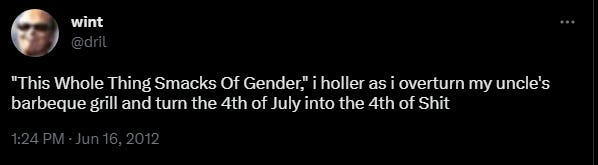
Ernest Hemingway—as well as his fellow perpetrators of Hemingwayism, such as Raymond Chandler—is the most infamously manly writer of the 20th century. This is real literary masculinity: spare and restrained prose, transparent narration, characters who are repressed to the point of emotional constipation, and it’s all about bullfighters or fisherman or something manly like that. Compared to Hemingway, the nineteenth-century writers seem frankly effeminate: their lush and overwrought prose, their omniscient narrators who continually interrupt the story, their emotion and archetypicality and frank sentimentality. I really do think this is all down to writers thinking that sitting in their rooms typing all day is a girly-man activity, and if they can’t go out to fight the Fascists in the Spanish Civil War the least they can do is stop using adverbs.
(”But some of the writers who are opposed to adverbs are women--” And you think female writers can’t be anxious about not being masculine-and-therefore-good enough? Is this your first time?)
But I for one am tired of writers’ gender anxiety getting in the way of them writing stories I enjoy. Hemingway is a good writer, and modeling yourself after him is fine. If you want to write an entire book with nothing but nouns, verbs, and articles, knock yourself out. But I love adjectives, adverbs, figurative language, exclamation points, sentences that take up half a page, melodrama, sentimentality, archetype, crying, and the omniscient voice. I even like it when authors put their blog post into the middle of their book for no reason. And I am tired of writing-advice books saying that everything I like in books is bad writing.
The nineteenth century was Peak Novel. RETVRN.
For example, a character who’s unhappy might describe the weather as “stifling heat,” while a happy character might describe it as “a pleasant summer day.”
For the third-person limited thing, blame Henry James! I was taught at least that his more and more austere avoidance of "head-hopping" over the course of his career (up to the full third-person limited of something like The Ambassadors in 1903) loomed over the first generations of twentieth-century authors as much as Hemingway does over us, and that a dogmatic commitment to his writing advice (which was based on various weird theories of his like the superiority of theater) basically killed off the Victorian omniscient narrator. Which I guess also goes to show how arbitrary these things can be, since James's long, convoluted sentences, especially in his later career, make Peake and Tolkien look like telegraph operators.
Also, I think it's kind of sad how Hemingway's minimalism has become synonymous with Being A Real Man and a sort of populist blue-collar aesthetic (which he himself did a lot to encourage of course). His literary mentor was Gertrude Stein, who did incredibly challenging, experimental minimalist prose-poetry, and Hemingway's writing kind of has one foot in that queer, experimental modernist moment he came out of and one foot in the gritty, masculinist later twentieth century stuff that grew out of him, so that you can kind of read something like The Sun Also Rises "from either direction" and come away with very different ideas about what he's doing. I find Gertrude Stein more interesting than Raymond Chandler so I guess I'm a little defensive of Hemingway when people come at him "from the other end", but that just goes to show even more how contingent and historically embedded Hemingway's advice was and how little it's a timeless gospel of how to "write well" in general.
I'm not a lover of purple prose or melodrama, but both those words imply *too much* of a thing that is, in normal amounts, just fine. Writing fanfic has taught me to have a lot less anxiety about the line between lush and purple, or drama and melodrama, because the line is further out than you think. Readers love the richer stuff.
Shyness, fear of being Cringe, causes people to edge way back of that line, convinced the readers will judge it harshly. It's like wearing jeans all the time for fear that any kind of "fancy" style will get you laughed at.
A lot of it is just a matter of practice, and discovering what *you* like, without the thought of a merciless audience picking apart your adverbs. You get a better sense of the line then. But you can't get a sense of it if you're always so afraid of it you cower 20 yards back writing like Asimov. (No shade to Asimov, but his dictate that no one should notice your writing held me back far too long.) You gotta dance around the line a bit, take risks, edit stuff out only when you know you've gone over.